
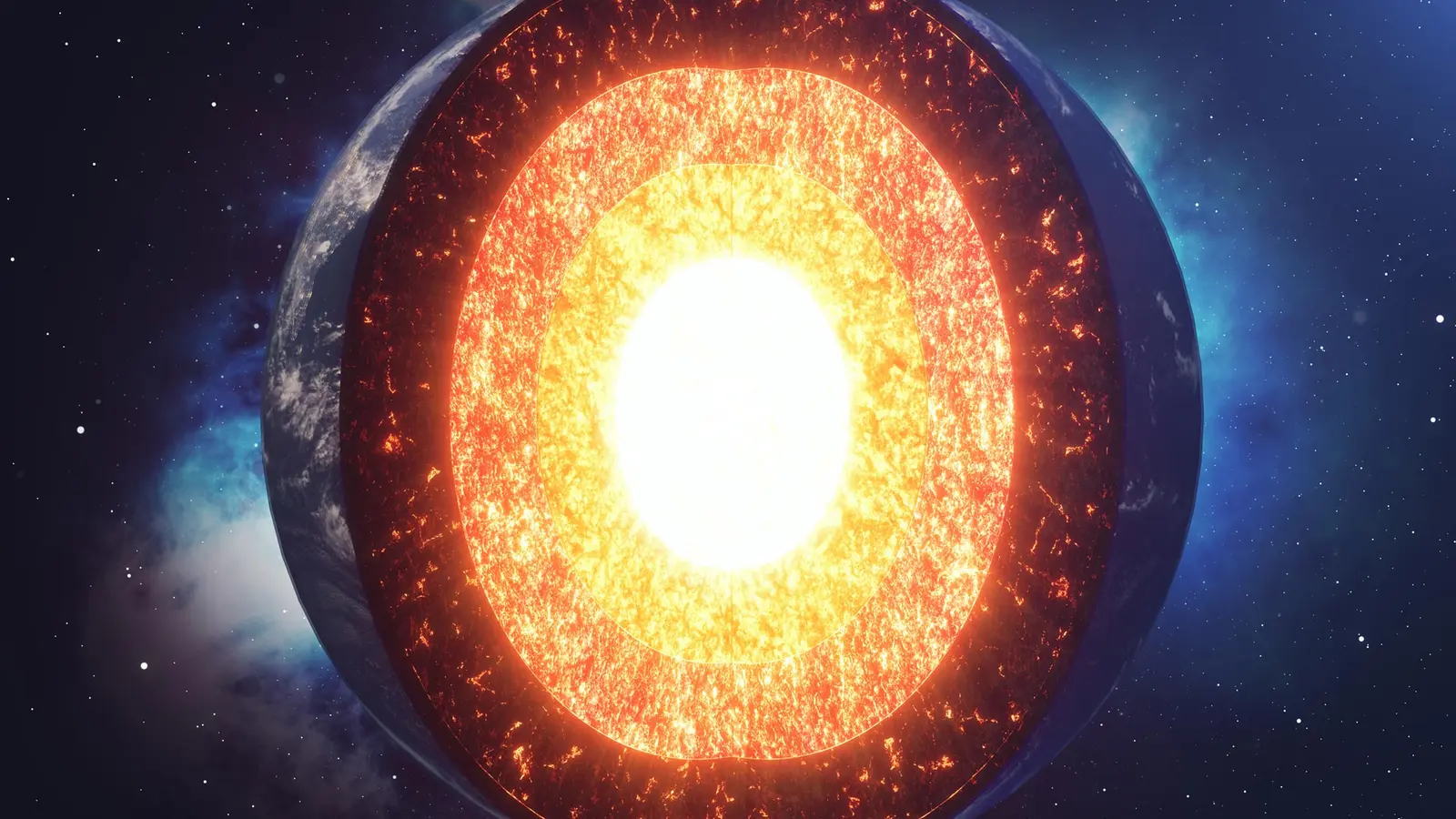
Imagine tiny rivers of hydrogen threading through solid iron deep beneath your feet. It sounds like science fiction, but new laboratory work suggests that, under the crushing pressures and blistering heat of Earth’s inner core, hydrogen can flow inside an iron lattice while the iron itself stays solid.
Researchers have found experimental evidence that hydrogen can become highly mobile within solid iron at extreme pressures and temperatures.
Probing the core in miniature
To study matter under conditions that hardly exist anywhere on the planet, scientists at the Institute of Science Tokyo recreated a sliver of the inner core inside a diamond-anvil cell. Tiny samples of face-centered cubic iron hydride, FeHX, were squeezed to pressures between 50 and 110 gigapascals and heated with lasers beyond 2,000 Kelvin. All the while, time-resolved synchrotron X-ray diffraction tracked how the crystal lattice changed as temperature and pressure climbed.
Iron hydride was compressed in a laser-heated diamond-anvil cell and analyzed using synchrotron X-ray diffraction, revealing evidence of a superionic state.
Why this setup matters: diamond-anvil cells can mimic the immense stress of planetary interiors in a sample millimeters across, and synchrotron XRD reads the structure with subatomic precision. The team, led by doctoral students Yoshihiro Nagaya and Yusuke Okazaki and Professor Kenji Ohta, watched the lattice volume evolve as hydrogen entered and rearranged within the iron matrix. At a critical temperature close to 1,590 Kelvin, the data showed a characteristic lambda-shaped anomaly in the thermal expansion coefficient—a hallmark of a phase transition seen previously in other superionic materials.
The anomaly allowed the researchers to draw a boundary between ordinary solid FeHX and a superionic phase in which hydrogen becomes highly mobile while the iron lattice remains largely intact. Extrapolating that boundary to the pressures expected in Earth’s inner core puts the predicted transition temperature comfortably below current inner-core temperature estimates. In short: the conditions at the center of our planet would favor a superionic form of hydrogen-bearing iron.
What this means for core dynamics and seismic signals
Superionic behavior is not just a curiosity. If hydrogen moves through an otherwise rigid iron lattice, the aggregate mechanical properties change. A lattice softened against shear could explain some puzzling observations: seismic shear waves travel surprisingly slowly through the inner core compared with simple iron models. Mobile light elements like hydrogen provide a plausible mechanism that reduces shear rigidity without completely melting the core.
The team pushed beyond structural signatures to test whether hydrogen really became mobile. During a second set of time-resolved XRD experiments, they applied a voltage across the heated, pressurized samples and observed a sudden redistribution of hydrogen along the sample axis. Cooling the sample rapidly trapped that redistribution, offering direct experimental evidence that hydrogen had migrated during the high-temperature phase. From the sample geometry and applied bias, the researchers estimated a mobility on the order of 1 µm2 J^-1 s^-1 and inferred a diffusion coefficient around 10^3 µm2 s^-1.
Those numbers sound large, but the scale and timescales matter. Migration driven by Earth’s geomagnetic field would move hydrogen only some 0.1 µm over 10,000 years. At that pace, crossing a distance comparable to the inner core’s radius of roughly 1,200 km would take more than a hundred times the age of the planet. So while hydrogen can flow inside iron at inner-core conditions, it would still be effectively trapped on geological timescales. Material accreted during Earth’s formation could remain locked inside the core for the planet’s lifetime.
Broader implications and next steps
These experiments supply a missing piece in the puzzle of inner-core composition. Previously, the superionic hypothesis rested mainly on molecular-dynamics simulations and theoretical predictions. Direct laboratory evidence strengthens the case that light elements—hydrogen among them—help shape the mechanical, thermal, and electromagnetic behavior of Earth’s deepest regions.
Questions remain. How much hydrogen can the core actually host? Does superionic transport couple to magnetic or convective processes in the outer core? And how do oxygen, carbon, or silicon interact with hydrogen-rich phases under similar conditions? Answering these will require complementary approaches: more laboratory runs at even higher pressures and temperatures, refined diffusion measurements, and improved geophysical models that fold this new data into predictions of seismic anisotropy and core evolution.
Expert Insight
"This work moves the conversation from theory to tangible experiment," says Dr. Elena Marconi, a geophysicist not involved with the study. "Seeing hydrogen redistribute in a laser-heated sample is convincing evidence that superionic phases are real possibilities inside planets. It forces us to revisit models of core dynamics and thermal history with fresh eyes."
Professor Kenji Ohta and his students emphasize that the superionic state of iron–light-element alloys can exist only under ultrahigh pressures and ultrahigh temperatures, which is why it had escaped direct observation until now. Their findings, published in Nature Geoscience, add an experimental anchor to decades of simulation-driven speculation.
Conclusion
Hydrogen’s ability to move through a solid iron framework at core-like conditions reframes our view of Earth’s center. The inner core may be more complex than a simple iron sphere: a rigid scaffold threaded with mobile light elements that influence seismic behavior, chemical evolution, and long-term retention of primordial ingredients. The discovery is a reminder that even the densest, least accessible parts of our planet can harbor surprising internal motion.
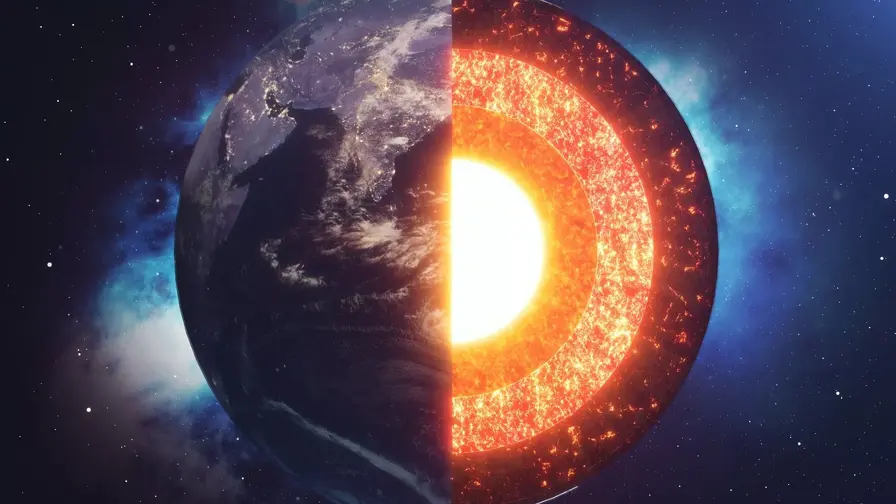
Key takeaway: under inner-core conditions, iron hydride can enter a superionic state where hydrogen flows through a solid iron lattice, a behavior with measurable effects on core properties and deep-Earth evolution.

“The cosmos has always fascinated me. I write about space missions, astronomy, and the technologies pushing humanity beyond Earth.”

Discussion
Leave a Comment
Comments (3)
Makes sense tbh. Mobile H lowering shear fits the weird seismic data. Still curious tho — how much hydrogen can the core realistically host, any estimates?
Is this even true? Lab setups are neat but extrapolating to the whole core seems risky. How robust are those diffusion estimates, and could other elements mimic the signal??
Whoa, tiny hydrogen rivers inside solid iron? mind blown. If true this could rewrite core models, wonder how much H there actually is...