
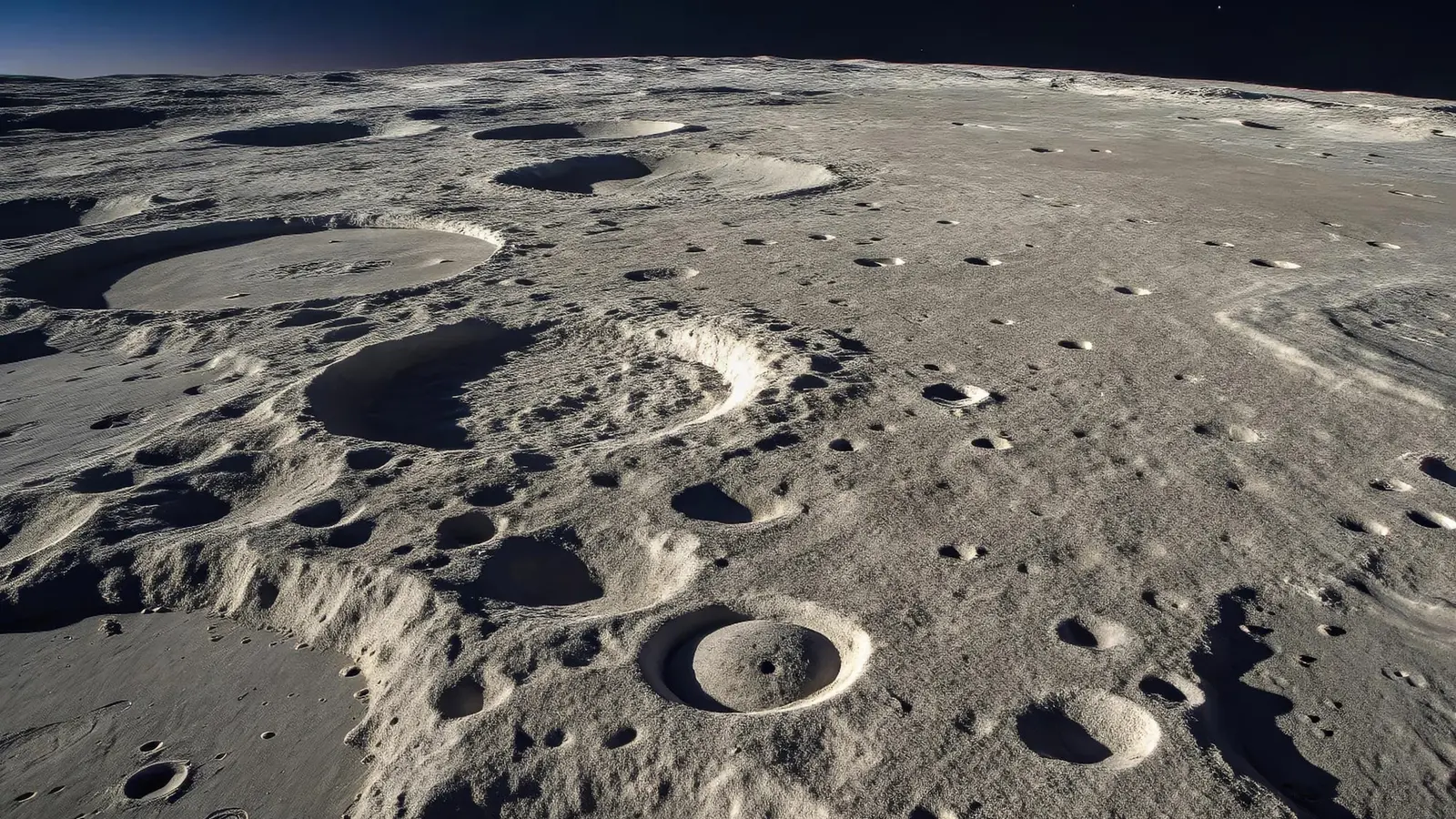
Imagine an astronaut’s footprint on the Moon, a tiny crater of displaced dust that also carries a storm of microbes. A pinky-nail-sized patch of skin can host a million bacteria. Multiply that by the number of footsteps, tools, and equipment involved in a mission and the Moon’s surface becomes an unintentional biological footprint.
New modeling from NASA and the University of Maryland suggests these hitchhikers might find brief refuges in the dim hollows near the lunar south pole. Rather than the flat, bake-and-blast environment most people picture, polar terrain is stitched with deep shadows and complex light paths. Those niches could cut UV exposure and temperature swings enough that some bacteria and fungi survive for days.
Why polar shadows matter
The Moon tilts almost upright relative to the Sun. That means sunlight skims the horizon near the poles. Even modest rises or a boulder can stop direct sun from reaching a depression. The result is a landscape peppered with long, cold shadows where sunlight—and the damaging ultraviolet radiation that sterilizes surfaces—is greatly reduced or scattered.
Previous assessments concluded microbial survival on the lunar surface was extremely unlikely. Those studies primarily examined equatorial sites visited by Apollo crews where sunlight is harsh and direct. They did not fully account for the way topography reshapes illumination at high latitudes. That oversight is crucial now because both robotic and crewed missions, including future Artemis operations, are aiming at polar regions for their water ice and scientific interest.
How the team modeled microbe-friendly niches
Researchers focused on candidate landing areas near the south pole, including places near De Gerlache and other potential Artemis III targets. They combined high-resolution elevation and temperature maps from NASA’s Lunar Reconnaissance Orbiter with optical modeling and ray tracing. Ray tracing follows light as it bounces, scatters, and grazes over every bump, slope, and rock. Applied to lunar terrain, it reveals where even indirectly scattered UV can reach and where it cannot.
The team also used data from the Lunar Orbiter Laser Altimeter to capture fine-grain details of surface brightness, slopes, and roughness. That allowed simulation of real-world scenarios: footprints, hardware shadows, and how low-angle sunlight changes across the lunar day and season. The result is a nuanced map of where radiation and peak summer temperatures fall below thresholds that some Earth microbes can tolerate.
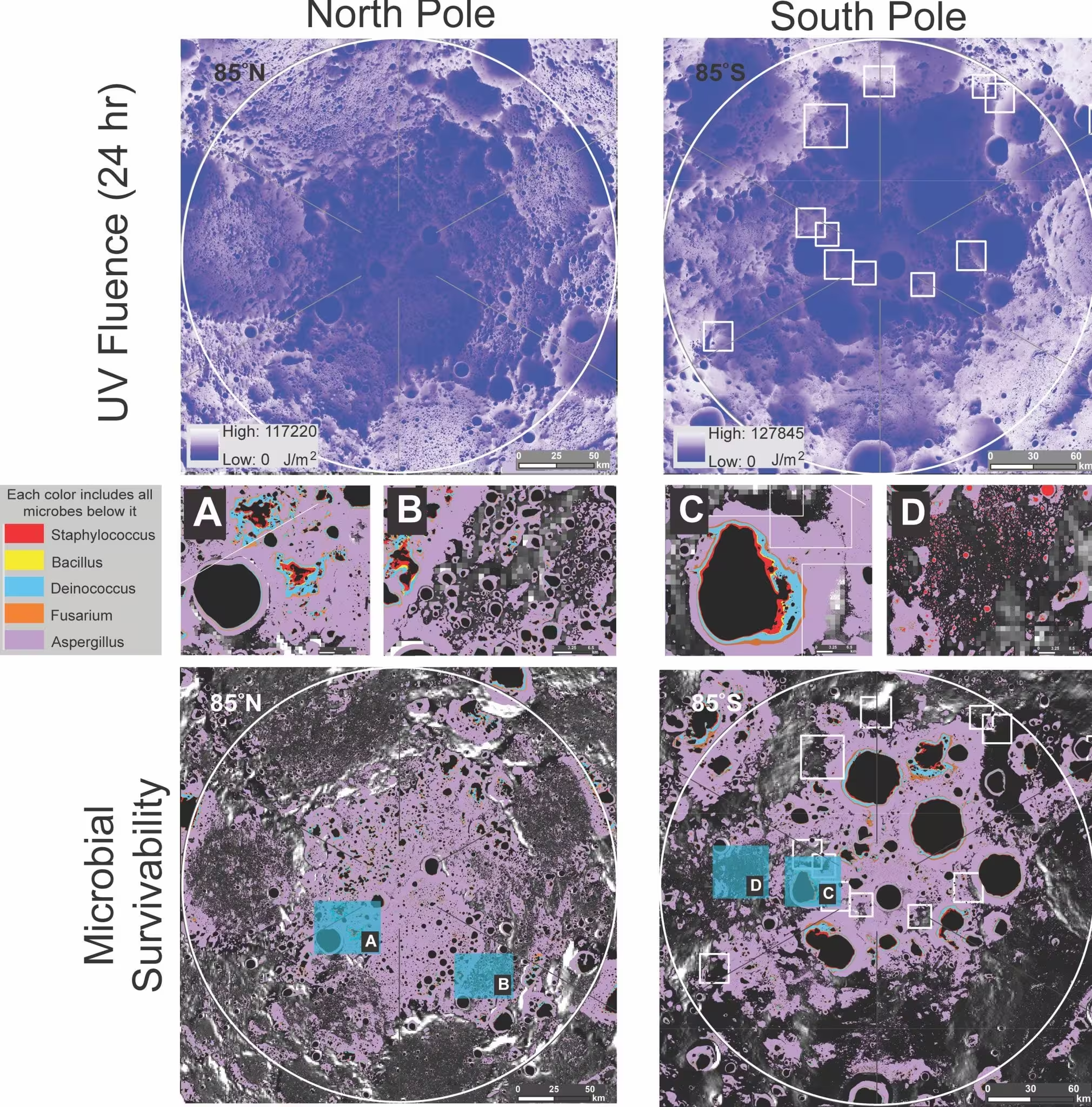
Microbial survivability in the Moon’s polar regions. Top panels show 24-hour UV exposure; bottom panels identify areas where microbes may survive based on UV and maximum summer temperature, with permanently shadowed regions in black. Panels highlight survivability near the north and south poles, including De Gerlache, while white squares mark Artemis III candidate regions and circles indicate 85° latitude.
What survived the simulations
The team ran models for microbes commonly associated with humans and the spacecraft environment, including several hardy bacteria and fungal strains. The results revealed pockets where survival time could stretch to about seven days under current assumptions. Survivability varied widely by species. Aspergillus, a fungus noted for its UV resilience, consistently fared best. Models suggest Aspergillus could persist across 15 to 30 percent of areas receiving some sunlight during lunar winter and in roughly 3 percent of mapped terrain for at least seven days.
Other organisms showed smaller but nonzero survivable zones. In multiple modeled regions, including permanently shaded areas of the De Gerlache Rim, every organism tested had locations where indirect light and lower peak temperatures would permit persistence. Persistence here means the cells remain intact and viable but not actively growing. On the Moon, liquid water and an atmosphere are absent, so reproduction is unlikely unless conditions change dramatically.
Survival without growth still matters. If material left by humans remains viable on the lunar surface, it complicates interpretation of future life-detection experiments and planetary protection. Distinguishing native chemistry or ancient biology from contamination introduced by spacecraft becomes harder when Earth microbes persist, even transiently.
Implications for exploration and science
Human missions bring a constant cascade of microbes. Skin flakes, breath condensate, and interior dust all act as vectors. An astronaut’s boot could deposit millions of cells. Even stringent sterilization protocols cannot eliminate the risk entirely. Understanding where microbes can hide helps mission designers plan landings, sample collection, and contamination controls.
There is also an opportunity. The Moon’s extreme, simple environment can serve as a natural laboratory for testing the limits of terrestrial life. Controlled experiments in shaded polar terrain would let scientists observe how microbes respond to prolonged cold, vacuum, low pressures of scattered UV, and abrupt thermal cycling. Those results would improve models for both planetary protection and astrobiology.
At the same time, the research underscores a policy challenge. As missions extend stays on the Moon and prepare for Mars, planners must weigh scientific goals against contamination risk. When searching for signs of life on Mars, for instance, confirming that a detected molecule or microbe is not a transported Earth contaminant will be essential. The Moon becomes the first testbed for those lessons.
Expert Insight
"What surprised many of us was the color on the maps," said Stefano Bertone, associate research scientist at the University of Maryland, reflecting on the variety of microbe-friendly zones the team identified. "Topography does more than sculpt the landscape. It sculpts light itself. That changes the survival story."
Dr. Prabal Saxena of NASA’s Goddard Space Flight Center, who led the study effort, noted, "We need to know what we bring with us. Only by understanding the baseline can we design better contamination controls for future life-detection missions."
To add practical perspective, a fictional but realistic space biologist, Dr. Elena Mora, commented: "The Moon gives us a unique, pragmatic test environment. If microbes persist here under precise, repeatable conditions, we learn how to detect and contain them before they confound discoveries on Mars or icy moons."
Next steps and technology
The authors plan to refine their models with higher-resolution topography and more advanced illumination techniques. One promising approach, called shape-from-shading, reconstructs 3D terrain from 2D images by analyzing light intensity and shadow geometry. Combined with focused laboratory work that simulates vacuum, temperature swings, and scattered UV, these refinements will constrain survival windows and identify which surface textures and slopes most effectively protect microbes.
Operationally, mission teams can use such targeted maps to choose landing sites, route rovers, and prioritize where to sample or avoid. Contamination mitigation strategies may include localized sterilization, restricted transit through sensitive zones, and protocols for handling equipment that could transport biological material into shaded hollows.
Conclusion
The lunar south pole is not uniformly sterile. Its stitched patterns of light and dark create microclimates where some Earth microbes could persist for days. That persistence does not equal growth, but it does matter: for planetary protection, for the integrity of science, and for how humans plan extended operations beyond Earth. The Moon offers both a hazard and a laboratory. Understanding where microbes can hide will shape the next decade of exploration.


“The cosmos has always fascinated me. I write about space missions, astronomy, and the technologies pushing humanity beyond Earth.”

Discussion
Leave a Comment
Comments (3)
feels a bit overhyped, like 'moon microbes for a week' seems dramatic. still useful for policy, maps could guide landings. But where's the experimental proof?
Is this even true? Models are neat but without real vacuum tests, seems like modeling hype. show me lab results pls...
wow that blew my mind, tiny shadowed pockets protecting stowaway microbes? unsettling, kinda fascinating actually.. we need stricter protocols.