
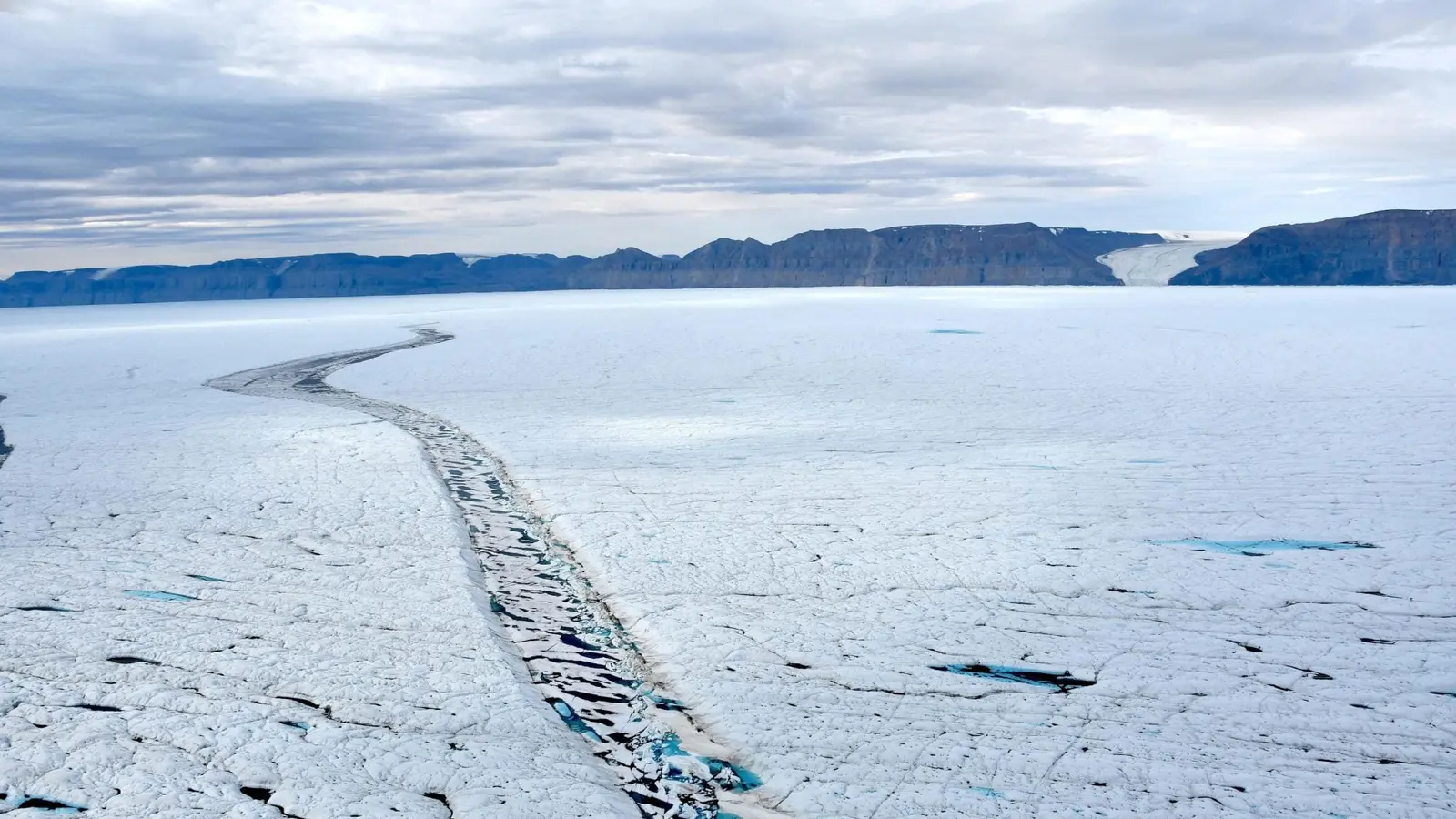
A slab of ice the size of Manhattan tore free from Petermann Glacier on 4 August 2026. The break created a tabular ice island of about 76.4 km² and up to 150 meters thick. Scientists watching the glacier say this is Petermann’s largest floating-ice loss since 2012 and the biggest Arctic calving event recorded since 2020.
How the ice island came loose
The separation began as a slow, predictable cracking. Satellite records going back to 2019 show progressive widening of fractures and weakening of the glacier’s floating ice tongue. On 3 August, radar from the European Space Agency’s Sentinel-1 mission revealed pronounced weakness along the tongue’s centerline. By 20:00 UTC on 4 August, the tabular block had detached from the glacier’s eastern flank.
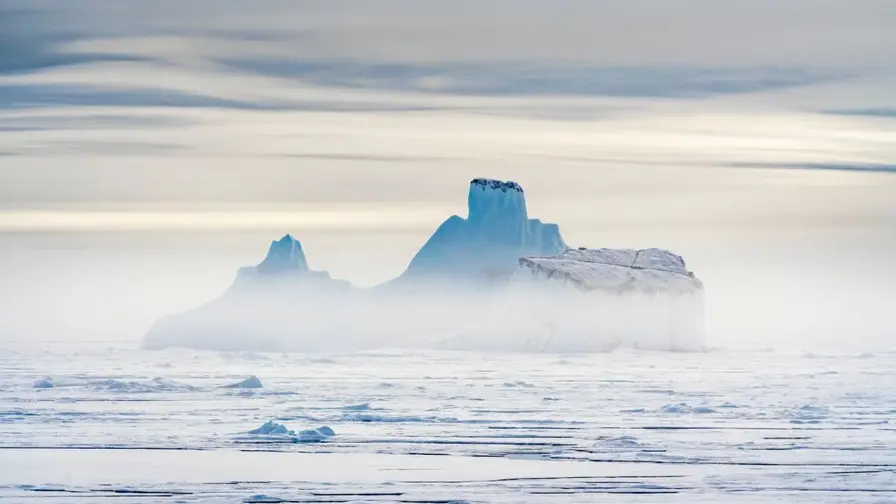
Tabular simply means the iceberg is flat-topped and roughly rectangular. Those shapes are common around Antarctica but far less so in the Arctic. The new island’s surface area is roughly comparable to Manhattan, which gives researchers a rare, natural experiment: watch how a large Arctic ice mass is born, drifts, fractures, and ultimately vanishes.

Satellite imagery of the calving.
Adam Garbo, a PhD student in glaciology at the University of Ottawa, was among the team who identified the event through an international collaboration involving researchers at the University of Stirling, Lancaster University, the University of Leeds, and Environment and Climate Change Canada. "Petermann Glacier has long been one of Greenland’s largest remaining ice tongues," Garbo says. "We’ve anticipated this break for years, and seeing it finally happen is remarkable."
What the break reveals and why it matters
At first glance, calving is a local spectacle: a huge block of floating ice becomes an independent object. But the implications are broader. Floating-ice tongues like Petermann act as buffers, slowing the flow of grounded ice behind them. When a tongue weakens or disintegrates, the glacier can speed up, delivering more ice from land into the ocean. That has consequences for glacier dynamics even if the floating piece itself does not raise global sea level when it calves.
Researchers are already tracking two additional rifts that could produce further large calvings in the near term. Projections suggest subsequent ice islands of roughly 94 km² and 84 km² could break away if the cracks continue to grow. Together with the newly detached block, those losses would remove about 254 km² from Petermann’s tongue, nearly 22 percent of that floating section.
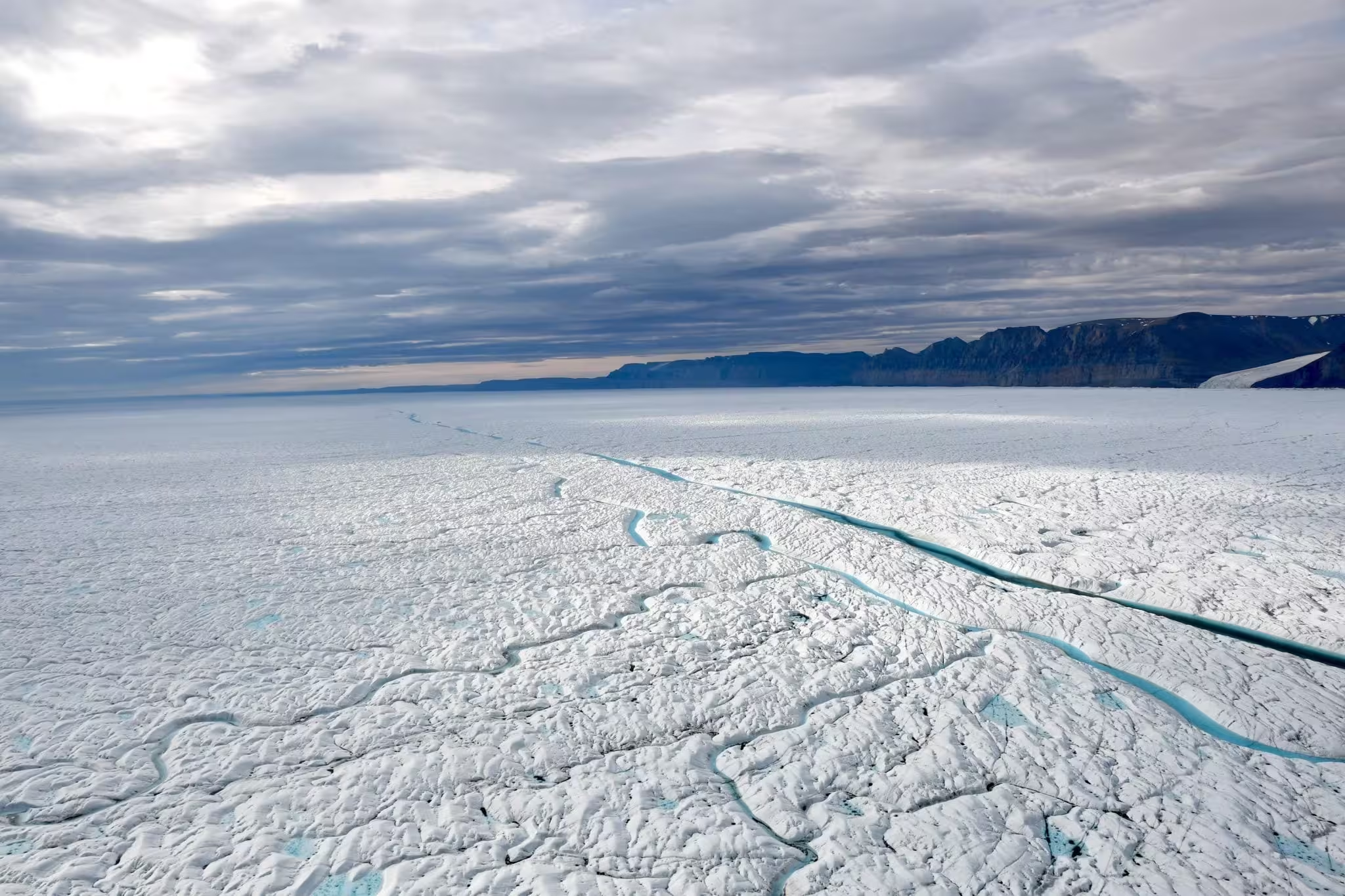
Petermann Glacier.
There is also a practical side to this science. Thick, tabular ice islands can drift for years and fracture into shards that are hard to track. Environment and Climate Change Canada is monitoring the new island to assess navigational hazards to vessels and risks to offshore operations. "These are thick blocks of ice that can drift for years," notes Dr. Abigail Dalton of the Canadian Ice Service. "Over time, they fracture into smaller, harder-to-track pieces that pose hazards to vessels and resource operations."
Observations, tools, and next steps
Teams will combine continuous satellite imagery, aerial surveys, and modelled drift trajectories to follow the ice island’s path. Radar satellites are essential because they can see through polar darkness and clouds. Optical imagery and targeted aircraft sorties add higher-resolution context, while oceanographic sensors help researchers understand how currents, temperature, and sea ice influence breakup and drift.
Studying an Arctic tabular iceberg also helps close knowledge gaps between the poles. "While large, tabular icebergs are relatively common in the Southern Ocean that surrounds the Antarctic Ice sheet, Arctic ice islands are far rarer," says Dr. Anna Crawford of the University of Stirling. "By studying Arctic ice islands, we will gain knowledge that can be transferred across polar regions."

Adam Garbo.
Expert Insight
Dr. Marcus E. Hall, a polar oceanographer who has modeled ice drift in the North Atlantic, commented on the event: "Large tabular pieces like this are natural laboratories. They let us see how currents, winds, and temperature gradients act on massive, coherent ice bodies. Monitoring their motion improves remnant-ice forecasting and gives maritime operators time to adapt. At the same time, these calvings are an early warning: they show how the coupling between ocean and ice can accelerate changes inland."
Conclusion
The Petermann calving on 4 August 2026 is both an acute event and a piece of a longer story about polar change. It gives scientists an uncommon window into how large Arctic ice bodies form and disintegrate, offers data that can improve drift and hazard forecasts, and signals evolving conditions at the glacier’s edge that may influence future ice loss. Teams will watch closely in the weeks and months ahead, tracking the new island’s course and preparing for the possibility of two more major detachments.

“The cosmos has always fascinated me. I write about space missions, astronomy, and the technologies pushing humanity beyond Earth.”

Discussion
Leave a Comment
Comments
No comments yet. Be the first.