
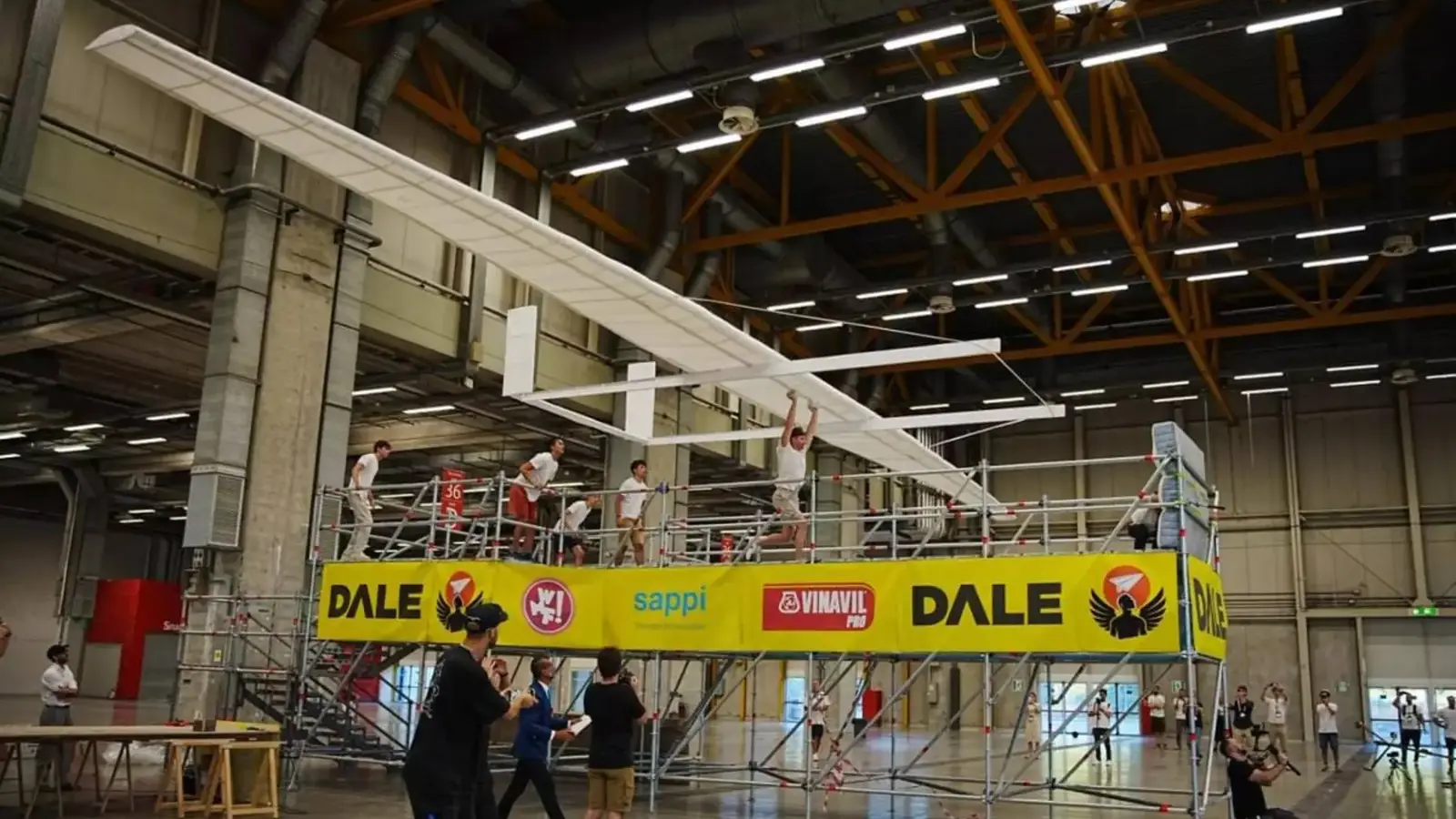
The crowd in Bologna watched a fragile giant take to the air. It did not roar. It glided, patient and precise, before settling after a 59 meter flight that earned a place in the Guinness World Records. The craft, named ICARUS, is not a whimsical art piece. It is an engineered machine made almost entirely of paper, a seven meter fuselage with more than 20 meters of wingspan and a flying weight close to 29 kilograms.
More than folding: engineering at scale
What looks like an oversized paper toy started with the same principles used in real aircraft design. Students at the University of Pisa spent months iterating on stability, load distribution, structural stiffness and aerodynamic form. Scaling a paper airplane up by orders of magnitude is not simple. Aerodynamic forces grow, materials behave differently, and tiny misalignments become decisive. The team experimented with wing geometry, launch velocity and weight balance until the numbers and the prototypes agreed.
The result incorporated internal spars and ribs inside the wings and fuselage, aerodynamic leading edges, and a functional tailplane. Layers of paper were glued in precise stacks to create panels that were light yet able to resist bending and shear. In load-bearing zones thicker paper provided strength; for the outer surfaces lighter sheets kept mass down. To increase stiffness without heavy weight, the builders bonded layers in honeycomb-like formations, a technique borrowed from aerospace composites where a high stiffness-to-weight ratio is essential.

Testing, rules and the run-up to record day
Guinness World Records defines strict conditions: launch by a single person from a platform no higher than three meters and a minimum flight distance of 15 meters. Those constraints forced the team to validate dozens of smaller models before committing to the final full-scale craft. Each test revealed new sensitivities: a wing twist a few millimeters off, humidity levels that softened adhesive bonds, or a subtle change in launch speed that altered lift production.
Building the final ICARUS required about 300 kilograms of paper and nearly 60 kilograms of glue. The heavy structural members used denser paper, while coverings were made from light sheets. Attention to construction detail paid off. On June 25, at the We Make Future technology event in Bologna the plane achieved a 59 meter free flight, vaulting past the prior record held since 2013 by Braunschweig University of Technology in Germany.
Jakopo D'Alessio, known online as Jakidale and a visible science communicator, worked with the students during development. He emphasized that the project’s value was more than the record itself. It was a lived lesson in practical engineering: resolving problems caused by moisture, balancing stiffness against mass, and tolerating only tiny dimensional errors.
Implications beyond the spectacle
At first glance, a 20 meter paper airplane might seem a novelty. But the techniques and problem solving behind ICARUS intersect with real engineering challenges. The team applied structural concepts used in aircraft and spacecraft: sandwich and honeycomb panels, optimized load paths and iterative wind tunnel-like testing with scale models. Those same ideas are relevant to low-cost prototyping, deployable structures, and educational programs that teach design thinking through hands-on fabrication.
There is also a public engagement payoff. Projects like this turn abstract physics and materials science into a shared, visible experiment. They invite students and the public to ask why things fly and to see how design choices link to performance. That curiosity is a practical engine for future engineers and designers.
Expert Insight
Dr. Elena Rossi, an aerospace engineer and lecturer in lightweight structures, commented on the project: "Scaling a paper design exposes the core trade-offs all engineers face. You must balance stiffness and mass, anticipate environmental effects such as humidity, and accept that manufacturing precision matters. The Pisa team demonstrated fundamentals that are directly transferable to lightweight aerospace concepts."
ICARUS was never meant to replace conventional aircraft. Its achievement lies in translating rigorous engineering into a material we usually associate with classroom folding. That translation, and the public attention it generated, make the record valuable beyond the measurement on the flight log. The plane flew far enough to prove a point: disciplined design, even with humble materials, can push the boundaries of what seems possible.

“The cosmos has always fascinated me. I write about space missions, astronomy, and the technologies pushing humanity beyond Earth.”

Discussion
Leave a Comment
Comments (2)
Cool stunt, but 300 kg paper and 60 kg glue feels a bit over the top, not very green. still, brilliant classroom demo, sparks curiosity
wow, a paper giant actually flew 59m? the blend of classic aerodynamics with crafty glue work is brilliant. humidity is the real enemy, tho. messy but inspiring