
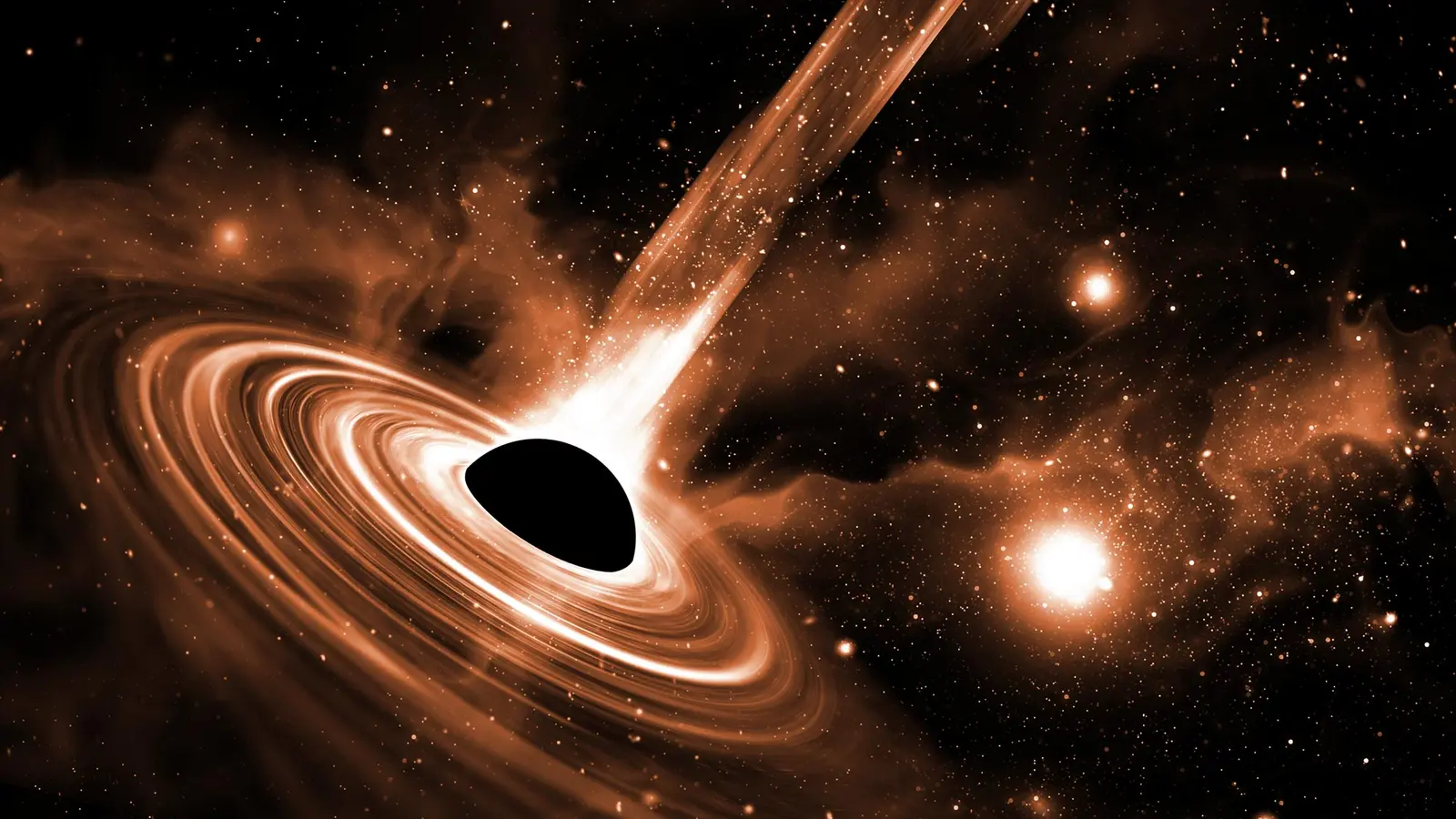
Picture a star that survives a violent close pass by a supermassive black hole, only to return months or years later and burst again like a wounded comet. Each reprise should look similar. Instead some of these cosmic returns grow steadily dimmer. That puzzle has nagged astronomers tracking repeating partial tidal disruption events, or rpTDEs.
At the heart of the matter is gravity doing two jobs at once. A black hole's tidal pull can strip gas from a star that skirts too near. If the star is not completely destroyed, its leftover core can keep circling the black hole and shed additional material each time it comes close. Those sheds fuel bright flares as the debris falls back and accretes onto the black hole. Simple, right? But observations have shown a quirk: several repeating systems show a clear decline in flare brightness from one passage to the next. Theoretical models had trouble reproducing that steady dimming.
Now a team led by doctoral student Ananya Bandopadhyay at Syracuse University suggests an elegant, physically motivated fix: the star's initial rotation matters. Their analysis, published in The Astrophysical Journal, invites us to think not only about mass loss and tidal torques but also about how a star's prior life influences what happens when it meets a black hole.
The observational riddle
Wide-field time-domain surveys repeatedly scan large swaths of the sky, catching transients as they brighten and fade. Among the handful of rpTDE candidates discovered so far, roughly four out of ten show decreasing peak luminosity across successive encounters.
Why is that surprising? Hydrodynamical simulations had already predicted that a star loses less mass on later passages as its outer layers are peeled away. But those same simulations often showed the flare brightness staying roughly constant. A countervailing effect was at work: tidal interactions torque the surviving star, spinning it up. Faster spin reduces the time spread of the returning debris, concentrating accretion into a shorter interval and preserving the flare's peak intensity.
So the models told researchers that declining mass loss alone could not produce fading peaks. Observers, however, kept seeing faded flares. The mismatch forced a deeper look at initial stellar conditions.
Spin changes the math

Bandopadhyay and collaborators revisited the simulations with a fresh variable: the star's pre-encounter spin rate. The idea is simple but powerful. A slowly rotating star will gain significant angular momentum from the black hole's tidal torque during each partial disruption. That progressive spin-up reduces the fallback timescale for the stripped gas, keeping flare peaks high even as total mass loss shrinks. A rapidly spinning star tells a different story.
If the star is already rotating quickly before its first close approach, subsequent tidal encounters add proportionally less spin. The fallback timescale remains relatively constant. With each passage, less mass is removed but the timing of its return to the black hole does not compress markedly. The peak accretion rate therefore falls, producing observationally dimmer flares over time. The result aligns with the fading pattern seen in several real rpTDE systems.
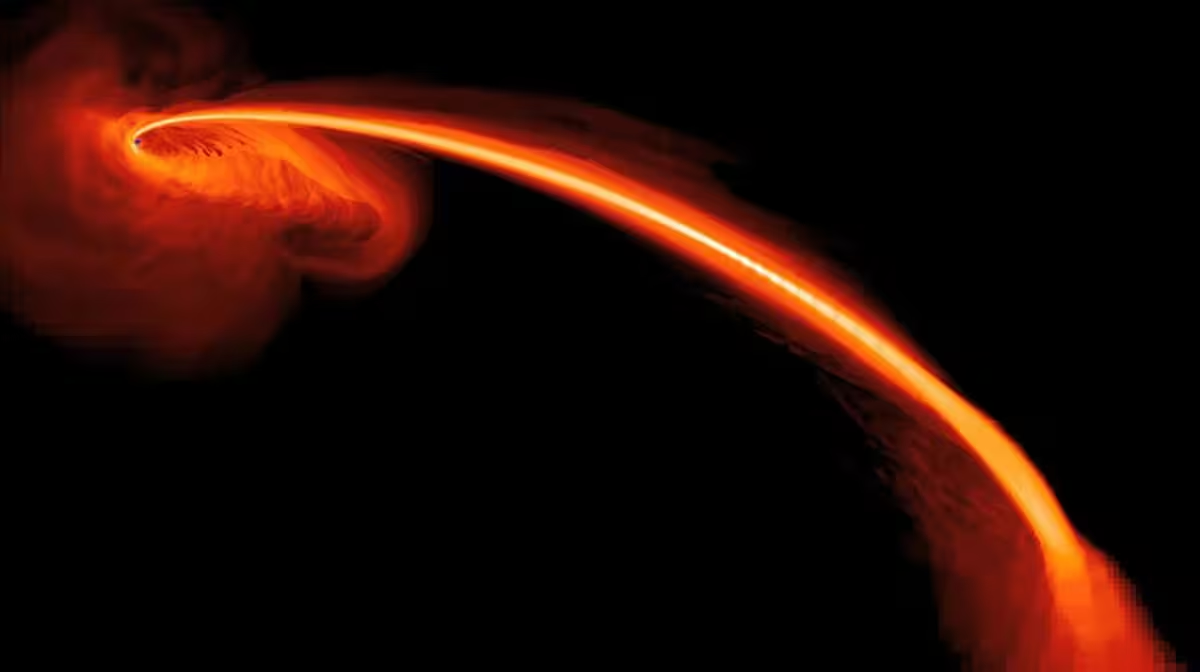
A hydrodynamical simulation of a star being ripped apart by the tidal forces of a supermassive black hole.
Beyond reproducing the luminosity decline, the model links two otherwise puzzling facts about these systems: why the surviving star orbits so tightly and why it might already be spinning fast. To explain both, the authors point to a mechanism first described by Hills in the 1980s.
Binary breakup and tidal locking
The Hills mechanism occurs when a tight stellar binary ventures near a supermassive black hole. The black hole's gravity can rip the pair apart, flinging one star outward and trapping the other on a close, eccentric orbit. If the original binary was compact, tidal forces between the two stars may have synchronized their rotation with their orbital motion. A very tight binary therefore produces a captured star that already spins quickly and orbits with a short period.
That scenario neatly supplies the missing initial condition in the new work. The captured star starts with high rotation. Later, during each partial tidal disruption, the spin-up from the black hole is modest, so the fallback profile of stripped material is relatively unchanged while the mass available for accretion steadily drops. The predicted flare peaks dim, matching the observations.

Eric Coughlin, an associate professor at Syracuse and coauthor on the study, notes that the same process could explain other unusual stellar populations around galactic centers. Some of the stars near Sagittarius A*, the Milky Way's central black hole, may have been deposited by Hills-like captures. If so, spin-influenced rpTDEs offer a window into both transient astrophysics and galactic center dynamics.
Implications for transient surveys and theory
This work has three practical consequences. First, it helps observers interpret long-term light curves from rpTDE candidates. When flares fade across encounters, a rapidly rotating progenitor becomes a plausible explanation. Second, it refines theoretical expectations for the fallback and accretion histories that power these transients. Modelers can now include initial spin as a routine parameter. Third, the connection with binary breakup suggests that follow-up studies of rpTDE hosts could reveal signatures of past dynamical interactions in galactic nuclei.
There are testable predictions. A spin-dominated fading sequence should show a specific relationship between the decline in peak luminosity and the fallback timescale. If future observations capture enough cycles, it will be possible to constrain the initial spin and infer whether the Hills mechanism supplied the star. Spectroscopic monitoring could further reveal changes in the composition and velocity structure of the debris, offering complementary clues.
Expert Insight
Dr. Lila Moreno, an astrophysicist who studies tidal interactions at the University of California, Santa Cruz, says, "This study is an elegant example of how a single, sometimes overlooked stellar property can reshape our interpretation of transient events. Rotation is not a secondary detail. It controls how material is shed and how quickly it comes back. If surveys keep finding fading rpTDEs, that pattern will point strongly to binary capture as a common origin."
Her remark highlights how revisions in initial assumptions can cascade into new observational strategies. The message for survey teams is clear: long time baselines and repeated spectroscopic follow-up are essential tools for diagnosing the life story of a TDE progenitor.
Conclusion

When a star meets a supermassive black hole, the encounter is shaped as much by the star's past as by the black hole's present pull. The Syracuse-led study shows that a star born spinning fast, perhaps the survivor of a binary breakup, will produce a different sequence of flares than a slowly rotating counterpart. Accounting for initial rotation resolves a long-standing mismatch between simulations and observations and links fading rpTDE light curves to binary dynamics in galactic centers.
The result tightens the dialogue between theory and observation. As time-domain facilities continue to sweep the sky, models that include realistic stellar spins and binary histories will be central to interpreting the most intriguing repeats. The faded flare is not a failure of physics. It is a signature, one that tells a deeper story about the star's origin and the dramatic forces that govern the centers of galaxies.

“My work centers on sustainability, energy, and environmental science — examining how innovation can lead to a greener future.”

Discussion
Leave a Comment
Comments (3)
Wait, so binary breakup must be common to explain most fades? seems a stretch, where's the stats on that… still curious tho
makes sense tbh, spin as a control parameter. neat fix to a nagging mismatch, now include spin in sims. curious to see actual numbers tho
Whoa, the idea that a star's prior spin decides whether flares fade is kinda gorgeous. Makes me wonder how common tight binaries are near SMBHs. Mind blown, need more data!