
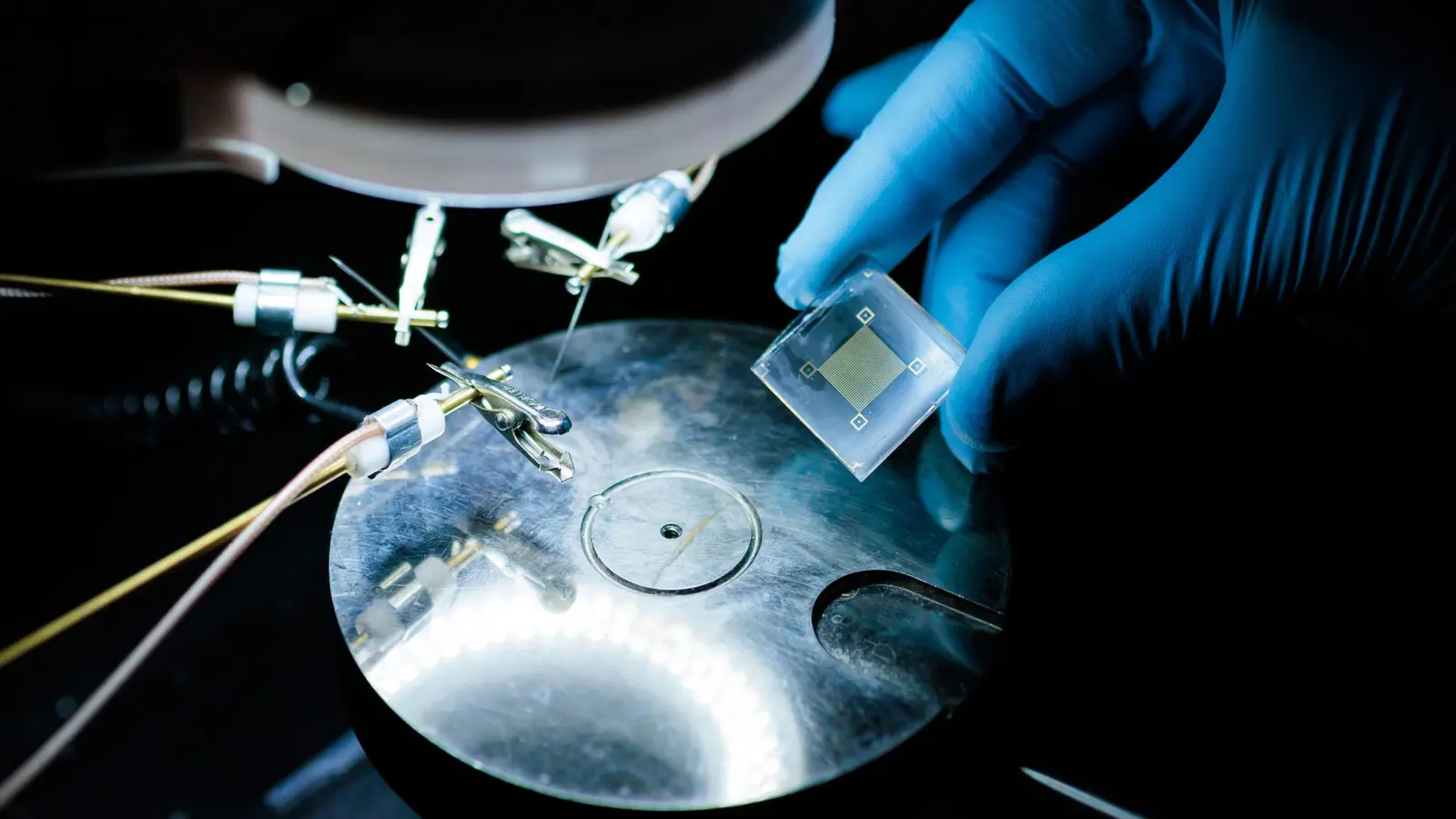
Imagine a thin, rubbery patch that clings to skin and thinks faster than a phone. It watches your heart, reads subtle signals, and decides in milliseconds whether you are in danger. That is what researchers at the University of Chicago and Argonne National Laboratory have been building: a stretchable, skin-like computing array that runs artificial intelligence right on the body.
Why local processing matters
Most wearables collect data but outsource the heavy thinking. They send heart rates and motion logs to distant servers, wait, and then return a verdict. That delay is usually fine. But sometimes it is not. Ventricular fibrillation, a chaotic and potentially lethal heart rhythm disturbance, unfolds in a blink. If you rely on a cloud round trip to decide what to do, you might miss the window to intervene.
So the team asked a practical question: can the computation be brought to the tissue itself? The answer they report in Nature Electronics is yes. By embedding neuromorphic circuits into a soft, stretchable substrate, they built a device that performs AI calculations in milliseconds without wireless handoffs.

The new device, designed and tested in collaboration with researchers at Argonne National Laboratory, was made possible by the development of manufacturing processes that allow organic electrochemical transistors to be printed onto flexible surfaces.
How the hardware mimics the brain
Traditional silicon transistors are binary workhorses. These organic electrochemical transistors behave more like synapses. They combine electrical currents with ionic movement inside a gel-like electrolyte, and that combination gives each transistor a short-term memory. Signals modify the device physically, so the component itself stores learned weights. It is neuromorphic computing translated into soft materials.
That approach brings both advantage and complication. Advantage: individual devices can integrate sensing and computation at the edge of the body. Complication: soft substrates do not tolerate heat or harsh solvents used in conventional chipmaking, and the gel electrolyte can flow and merge devices unless carefully confined. The researchers solved this by inventing a photopatternable polymer gel that hardens with ultraviolet light, enabling precise transistor arrays on materials that stretch like skin.
"The future that we’re trying to realize is to make wearable and implantable devices smarter," said Sihong Wang, associate professor of molecular engineering and co-senior author of the paper. "It’s helping people have a personal, instantaneous doctor integrated into their devices."
As Zixuan Zhao, a graduate student and co-first author, explained: "In hardware, a neural-network weight is a material—with variability, history, and physical limits. The challenge was to hold those constraints in mind and still compute with enough precision to matter."

University of Chicago Pritzker School of Molecular Engineering (UChicago PME) Assoc. Prof. Sihong Wang (right) and PhD student Max Weires hold a sample device.
Real-time cardiac mapping in practice
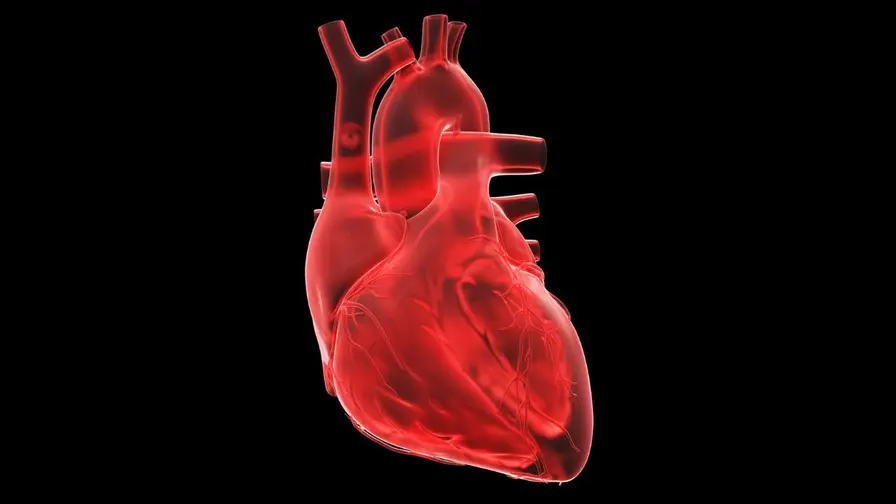
To show what on-body neuromorphic computing can actually do, the team encoded pretrained networks into the array and tested them with cardiac signals from a donated human heart. They asked the device to locate electrical wavefronts that indicate the beginnings of fibrillation. The array identified those wavefronts with 99.6 percent accuracy, even while stretched to more than 1.5 times its original length.
In another experiment they fed the array clinical metrics such as cholesterol, blood sugar, maximum heart rate, and ECG-derived features. The on-body neural network estimated heart-attack risk with an accuracy of 83.5 percent. Those numbers are not mere lab curiosities; they illustrate that computation embedded in flexible electronics can reach clinically relevant precision while surviving the mechanical realities of skin contact.
Why does that matter beyond emergencies? Because latency is a new kind of medical hazard. If decisions are slow, interventions are blunt. A fully integrated array could, in principle, detect a dangerous wave, compute where to nudge tissue electrically, and trigger a small corrective pulse before the aberrant rhythm spreads. Less shock. More finesse. Better outcomes.
Broader context and technical hurdles
This work sits at the intersection of materials science, microfabrication, and computational neuroscience. Organic electrochemical transistors render weights as material states rather than numbers. Photopatternable gels make high-density arrays possible. Stretchable wiring and soft wireless links remain necessary to turn a research prototype into a wearable product.
There are regulatory and biocompatibility questions too. Long-term adhesion to skin, immune response to implanted versions, power and energy budgets for continuous operation, and robust wireless protocols for emergency reporting are all active engineering tasks. The researchers are already working on stretchable communication layers and improved sensors that would let a single device sense, analyze, and respond in real time.
Expert Insight
"This is a meaningful step toward decentralizing medical intelligence," said Dr. Lena Ortiz, a cardiologist and biomedical engineer who was not involved in the study. "On-body neuromorphic hardware reduces latency and can change how we think about cardiac interventions. But translating lab accuracy into day-to-day clinical reliability will require rigorous trials and a focus on fail-safe mechanisms."
That sober perspective echoes the promise. Faster analysis is not a cure in itself. It is an enabler. It lets algorithms act where physiological events are occurring, rather than reacting after the fact.
Conclusion
The University of Chicago and Argonne teams have shown that skin-like neuromorphic patches can host real-time AI and survive stretching, while maintaining high accuracy for cardiac mapping and risk prediction. The work does more than demonstrate a clever component. It reframes a design philosophy: move the intelligence to the edge, to the tissue, to the place where milliseconds count.
Next steps will test durability, energy use, and the safety pathways needed for clinical use. If those hurdles are cleared, the patch could do more than monitor; it could participate in a closed-loop system that senses, decides, and acts—all where life happens.


“The cosmos has always fascinated me. I write about space missions, astronomy, and the technologies pushing humanity beyond Earth.”

Discussion
Leave a Comment
Comments (3)
Feels overhyped but okay. Impressive tech, yet 99.6% in controlled tests, not on sweaty commutes. regs gonna be brutal.
Is this even real outside the lab? How do they power it, stop hacking, and keep it stuck for weeks? sounds promising but skeptical.
wow, a skin patch that thinks faster than my phone? wild. imagining tiny brain-like patches nudging hearts in real time. but what about adhesion and immune response? scary