
Light does unexpected things when molecules are arranged with intention. A research team at Kyushu University has built a solid material that takes ordinary visible sunlight and produces ultraviolet photons at natural sunlight intensity. It is not magic. It is molecular engineering that finally tames a stubborn quantum trick outside of liquid solutions.
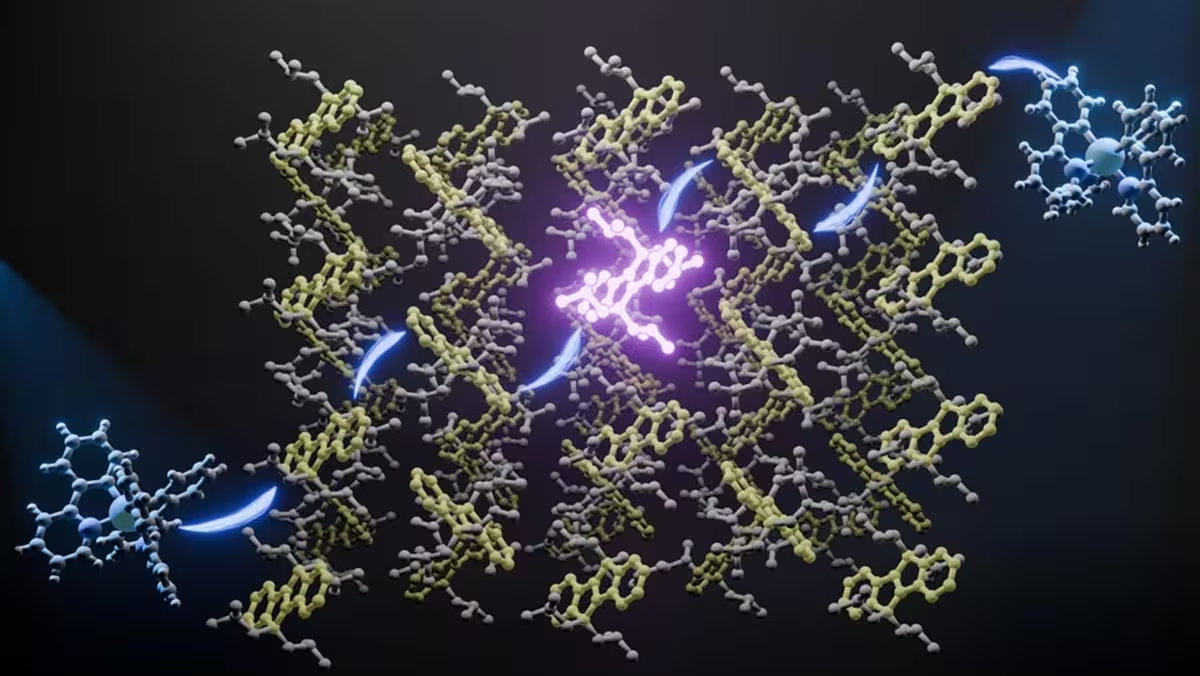
A new solid-state material from Kyushu University turns visible light into high-energy UV at sunlight intensity. By attaching alkyl chains to the sp3 carbon atoms of an organic molecule, the researchers create precisely controlled gaps between neighboring molecules. This spacing enables efficient triplet energy transfer, achieving a quantum yield above 60% in the solid state. When combined with a donor molecule, the system reaches 1.9% visible-to-UV upconversion efficiency.
How two photons become one with higher energy
What the team achieved relies on a quantum process called triplet-triplet annihilation upconversion. Think of two low-energy visible photons as small contributions that, when funneled through a pair of molecules, pool their energy to create a single photon in the ultraviolet band. That UV photon carries more energy than either original photon. It is an energy upshift rather than amplification in the classical sense.
In practice, a donor molecule absorbs visible light and is promoted to a triplet excited state. That energy hops to an acceptor. When two acceptor triplets meet, they can combine and emit a single higher-energy photon. This pathway works reliably in liquids because molecular motion brings triplets together. But solids present a double-edged sword: molecular proximity helps energy transfer, yet excessive electronic overlap kills the excited states before they can meet.
Designing distance with molecular precision
The Kyushu group addressed that paradox by using an organic semiconductor scaffold called dihydroindenoindenedene, abbreviated DHI. Instead of leaving molecules to touch as they would in a crystal, the researchers grafted alkyl chains onto DHI’s sp3 carbon sites. Those chains act like tiny molecular bumpers. They enforce an optimal spacing where excitons can migrate but are not quenched by strong pi-electron overlap.
The result is a solid film that retains long-lived triplet states and emits brightly under illumination. In photophysical tests the material achieved a fluorescence quantum yield exceeding 60 percent in the solid state. Paired with an appropriate donor, the full device reached a visible-to-UV upconversion efficiency of 1.9 percent when exposed to real sunlight outdoors. To put that number in perspective: roughly two ultraviolet photons are produced for every one hundred visible photons the donor absorbs. It sounds modest, but most prior solid-state systems failed to show meaningful upconversion even under much higher light intensities.
The underlying strategy is elegantly pragmatic. Keep molecules close enough to hand off energy, yet far enough to avoid premature loss. The alkyl chains give that balance. They are chemically simple and inexpensive to add, which matters when thinking about scaling from the laboratory bench to useful devices.
Applications that could run on a sunny day

Why chase UV production from sunlight? Ultraviolet light powers many processes: it drives photocatalytic reactions, sterilizes air and surfaces, cures resins used in 3D printing, and hardens certain dental and industrial materials. Solar panels and LEDs produce visible light efficiently, but converting that abundant visible portion into actionable UV at low intensity has long been a bottleneck for decentralized, sunlight-driven technologies.
The Kyushu material opens several possible pathways. Imagine low-intensity, solar-driven photocatalysis for water treatment in remote locations. Or compact devices that use ambient light to generate UV for air purification without high-voltage lamps. In additive manufacturing, sunlight-assisted curing could reduce energy demands or enable new portable printers that work outdoors or in indirect indoor light.
Practically speaking, the team has already filed a patent application. The chemistry relies on readily available starting compounds and straightforward synthesis, which shortens the timeline from proof of concept to prototype compared with exotic or costly materials.
How this project grew over a career
This breakthrough did not appear overnight. It builds on more than a decade of work led by Nobuo Kimizuka and collaborators exploring photon upconversion and self-assembling molecular systems. Early successes in liquids and gels demonstrated the core physics but left the solid-state challenge unresolved. In May 2024, a focused effort by graduate students Naoyuki Harada, Hayato Shoyama, Nutnicha Boonmong, and others, together with then Assistant Professor Kiichi Mizukami and Associate Professor Yoichi Sasaki, brought those threads together. The team delivered their results to Professor Kimizuka shortly before his retirement, a milestone that the group describes as both scientific closure and a fitting capstone.
Expert Insight
"This is an important step toward practical photon upconversion," says Dr. Laura Chen, a materials scientist who studies solar-driven catalysis at a national laboratory. "The clever use of alkyl spacers to tune intermolecular interactions is simple but powerful. For downstream applications, the challenge will be integrating these films into devices without degrading the excited-state lifetimes. Still, the efficiency reported under natural sunlight is notable and gives engineers a workable target."
Where the challenges remain
Questions remain before this chemistry reaches products. The reported 1.9 percent upconversion efficiency is measured under outdoor sunlight; device-level performance inside modules or integrated reactors may differ. Long-term stability under real-world weather, mechanical stress, and prolonged irradiation must be tested. There is also scope to optimize donor-acceptor pairings, film thickness, and encapsulation strategies to protect against oxygen and moisture, which can quench triplet states.
From a systems perspective, researchers will need to evaluate trade-offs: how much visible light must be diverted for UV generation versus retained for other functions, and whether hybrid approaches—combining photovoltaic power with localized upconversion—offer better overall efficiency for certain tasks.
Conclusion

Kyushu University’s molecular strategy restores a capability long confined to liquids: converting visible sunlight into ultraviolet light in a practical solid film. By engineering nanoscale spacing with alkyl chains, the team balanced energy transfer and exciton protection, producing measurable upconversion under real sunlight. The work is not the final answer, but it changes the game. It invites engineers and chemists to design devices that harness sunlight for UV-driven chemistry and manufacturing in places where conventional UV sources are impractical.

“The cosmos has always fascinated me. I write about space missions, astronomy, and the technologies pushing humanity beyond Earth.”

Discussion
Leave a Comment
Comments (3)
Feels a bit overhyped, 1.9% is tiny, but simple alkyl spacers are smart. scale-up and encapsulation will be the real test
Is the 1.9% measured under ideal sun only? Looks promising but oxygen, humidity and long term photobleach usually wreck triplets. anyone tested months?
wow this actually blew my mind. visible->UV in a solid? if it holds up outdoors, could be game changing. curious about durability..