
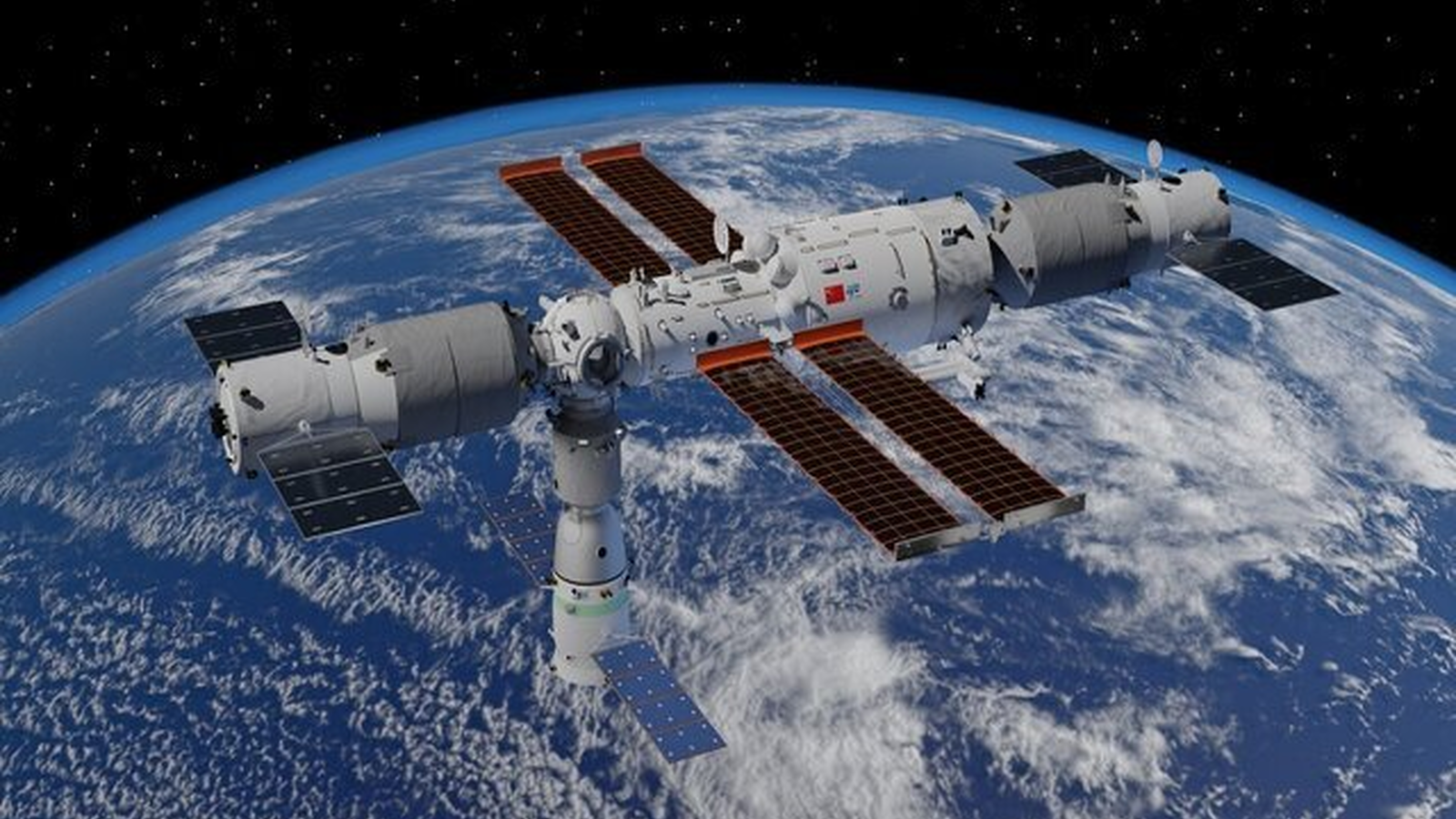
Picture two ghostly puffs of atoms, barely visible, drifting inside a module of the Tiangong space station as the world below spins. They fall together, not for a second, but for long enough to test one of physics' deepest assumptions.
That thought experiment is now reality. Researchers recreated a variant of the experiment famously attributed to Galileo, but at atomic scales and in orbit. Instead of lead or iron balls from a leaning tower, scientists released two clouds of ultracold rubidium atoms inside Tiangong and watched them fall under gravity. The twist: the two clouds had different nuclear compositions. One contained rubidium atoms with more neutrons than the other. If gravitational mass and inertial mass were not identical, the clouds should have accelerated differently. They did not.
How the orbital test worked
In practice, the team used laser cooling to form two cold rubidium ensembles and placed them in free fall within the station. Sensors tracked their relative motion while the environment offered a near-perfect microgravity laboratory. On Earth, air drag, seismic noise, and the short fall distance limit precision. In low Earth orbit, an object can remain in continuous free fall for extended periods, boosting sensitivity by orders of magnitude.
The result was striking. The accelerations of the two atom clouds matched to within 0.05 percent. That tiny fractional difference, or rather the lack of one, supports the weak equivalence principle: gravitational mass equals inertial mass. Those two concepts sound similar but are distinct in physics. Gravitational mass measures how strongly an object feels gravity. Inertial mass determines how much it resists acceleration when pushed. If they cancel out, mass disappears from acceleration equations and different masses fall together.

Tests of the equivalence principle are not merely academic. The principle underlies Einstein's general relativity, which describes gravity as the curvature of spacetime. Any violation could point to new forces or particles beyond the standard model, or to pathways toward a quantum theory of gravity. Previous space experiments dropped metal cylinders and other macroscopic test masses. This new study pushes the boundary into quantum territory by using atoms, which obey quantum mechanics as well as classical gravity.
Why atoms matter
Atoms are small and quantum. Their wave-like behavior can reveal effects that bulk objects hide. If gravity couples differently to different quantum states or to components of the nucleus, precision atom interferometry might catch it. So far, Tiangong's experiment finds no deviation. The observation therefore tightens constraints on theories that predict composition-dependent gravitational effects.
The work was published in Science Advances and joins a growing suite of precision measurements performed in space. Long free-fall times, quiet conditions, and improved interrogation techniques make orbit a compelling venue for fundamental physics. Expect more atom-interferometry missions, higher sensitivity, and tests that probe heavier atoms, antimatter, or entangled states.
For now, Galileo's simple intuition survives a hundredfold change in scale. Two different rubidium clouds fall together, as if gravity treats all matter the same. That agreement keeps general relativity standing, but it also narrows the room where new physics might hide.

“The cosmos has always fascinated me. I write about space missions, astronomy, and the technologies pushing humanity beyond Earth.”

Discussion
Leave a Comment
Comments (2)
Is this even true? 0.05% is tiny, but do they account for instrument bias, residual drag, magnetic effects etc. I wanna see raw data or methods…
whoa this is wild, atoms floating and behaving like tiny planets. kinda poetic, also reassuring? if only my plants fell that gracefully lol