
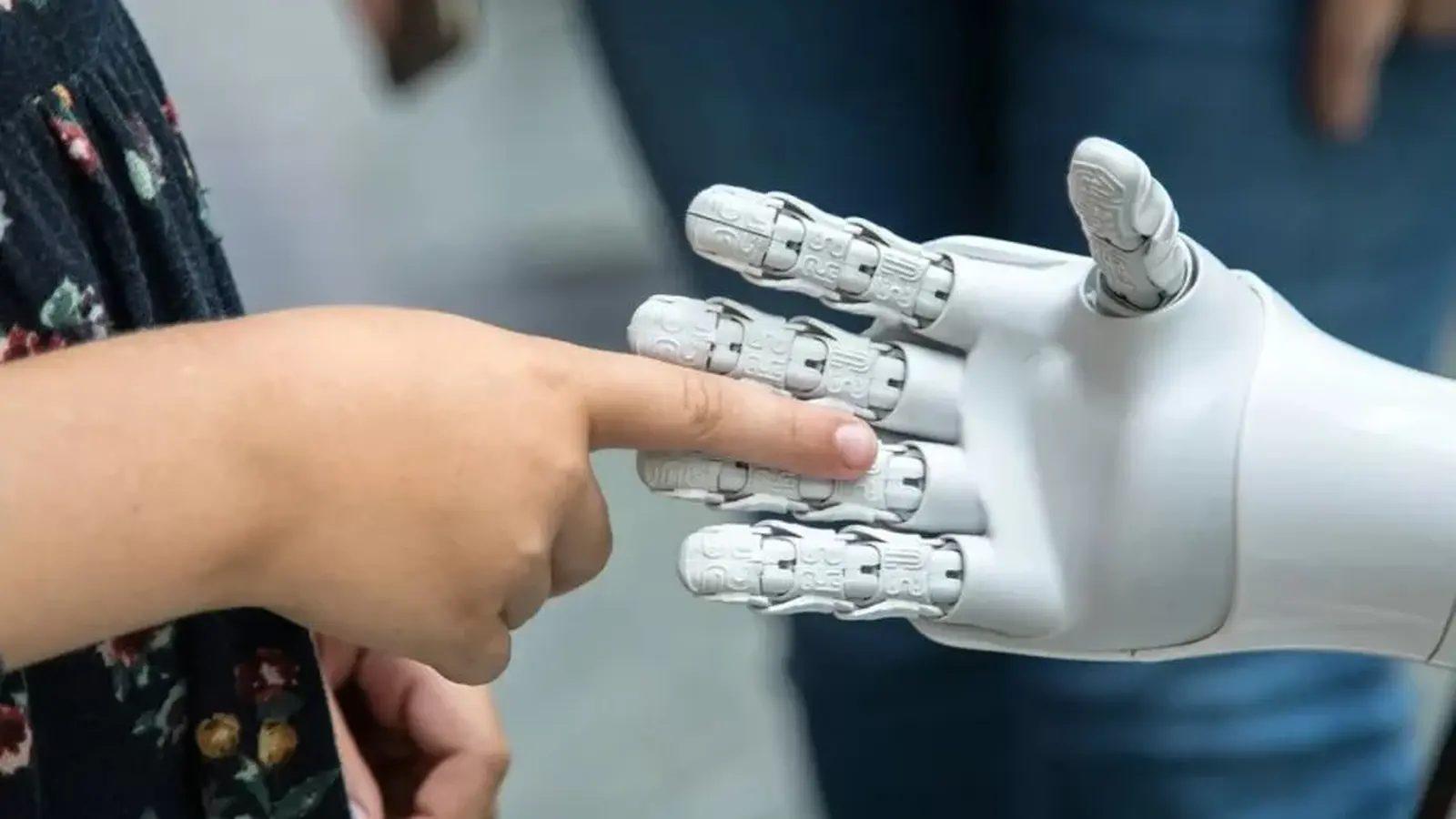
Imagine a robot lifting a porcelain cup and knowing, in an instant, how hard to hold it. Not by thousands of tiny electrical sensors. Not by slow calculations. Instead, the cup's touch paints the robot's skin with colors that a regular camera reads like a language.
Researchers at Queen Mary University of London have built a tactile sensor that turns pressure into visible color patterns. When the soft covering on a robotic surface is pressed, its material changes hue and pattern. A conventional camera captures that pattern and software interprets it as location, force and indentation depth. The approach swaps complex hardware for a clever, visual trick.
This is not sci‑fi. The team published their results in Science Advances and technology outlets quickly picked up the story. What makes the work striking is its simplicity. Install a mechanochromic film on a robot finger, point a low-cost camera at it, and the robot can read touch in real time. Simple optics replace arrays of micro-sensors. Data that used to be raw numbers now arrives as spatial color maps that are intuitive for both humans and machines.

How the idea works and why it matters
At the heart of the system is a soft layer whose optical properties shift when strained. Pressure changes the arrangement of pigments or microstructures in the material, producing a distinct color signature for each contact event. Cameras capture those signatures and neural networks or calibration algorithms translate them into tactile information. The result: accurate perception of where an object was touched, how hard, and how much the surface deformed.
Why is that useful? Because it addresses a long-standing trade-off in robotics: speed versus resolution. Traditional tactile systems often require dense sensor grids and heavy processing, which costs time and money. By encoding touch visually, the new method offers high-resolution feedback at camera framerates, improving both responsiveness and precision.
'By turning pressure into visible color patterns, we let a simple camera do the sensing,' the Queen Mary research team explained. 'This reduces wiring, lowers cost, and opens new possibilities for soft robotics and prosthetics.'

Practical applications are immediate and varied. Industrial robots could assemble miniature components with finer touch control. Prosthetic limbs equipped with such skins might give wearers a more natural sense of contact. Surgical robots could gain a safer touch, distinguishing fragile tissue from denser structures during delicate operations. In each case, seeing touch rather than measuring it electrically simplifies integration with existing machine vision systems.
There are challenges to solve. Visual tactile sensing depends on consistent lighting, robust materials that withstand abrasion, and calibration to translate color maps into accurate force measurements. Researchers are already testing different pigments and protective coatings to improve durability. Performance under flickering light and in cluttered visual scenes is another area for engineering work.
Still, the potential is clear. Swapping electrical complexity for optical clarity may be one of those elegant engineering moves that quietly shifts a field forward. If robots can look at their hands and understand touch, the door opens to machines that handle the world with a finer, safer touch.
For the technical details, see the Queen Mary University of London study in Science Advances and the coverage summarized by Digital Trends.

“The cosmos has always fascinated me. I write about space missions, astronomy, and the technologies pushing humanity beyond Earth.”

Discussion
Leave a Comment
Comments (2)
Is this even practical outside lab lighting? Cameras and colours sound neat but shadows, flicker and stains could wreck the signal... skeptical.
Whoa, robots that actually see touch? Mind blown. If the colours hold up under real grime this could be huge, curious…