
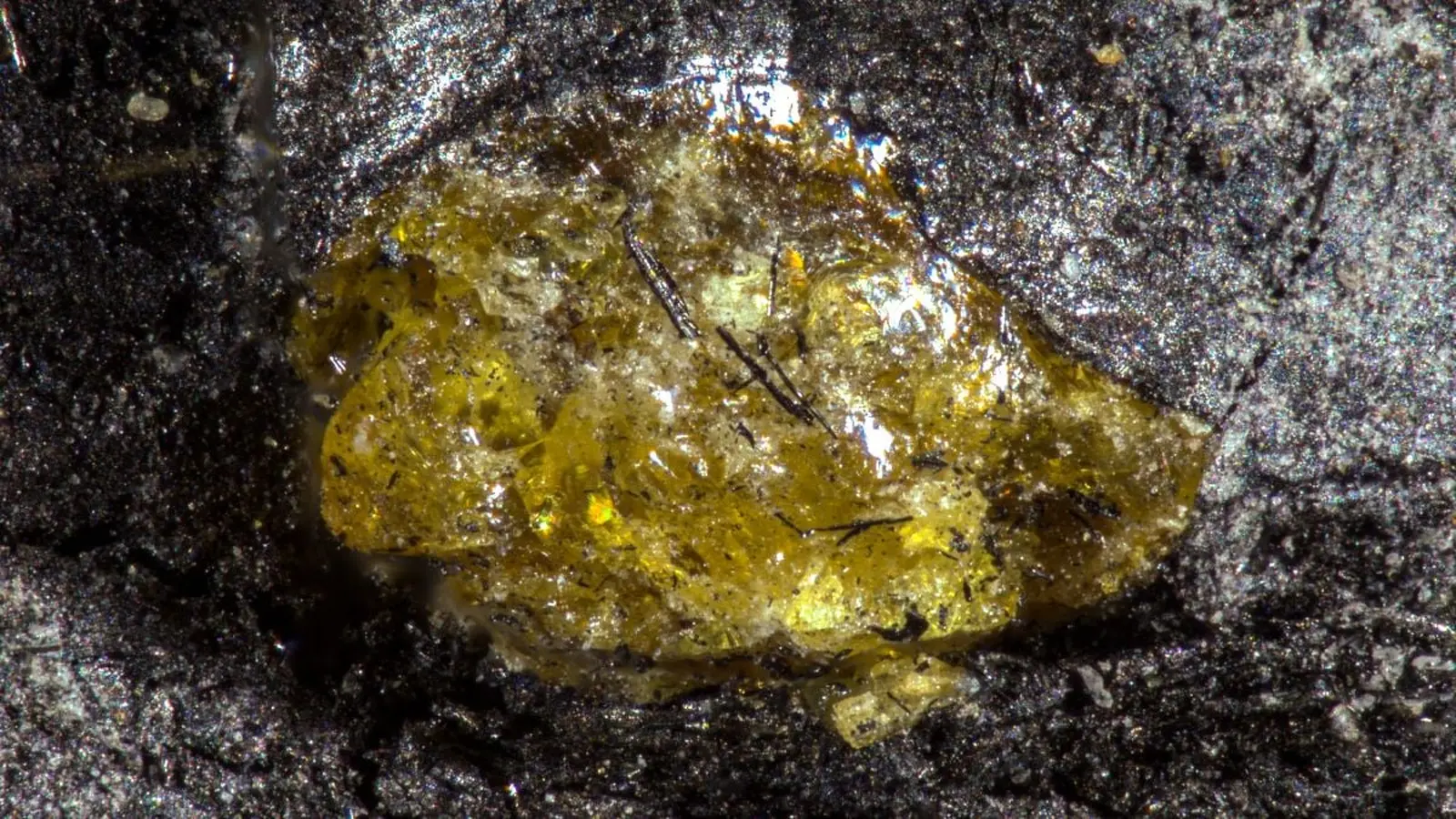
A tiny speck of fossil resin, no larger than a pinhead, has forced paleontologists to rethink when plants first learned to manufacture complex defensive chemicals. It is not the glittering, jewel-like amber collectors covet. Instead it is a scatter of microscopic grains hidden in an ancient coal seam that point to a biological skill developed far earlier than anyone expected.
When resin predates dinosaurs by 150 million years
The fragments came from the Hujiersite Formation in northwestern China. The host rock has been dated to the Middle Devonian, about 385 million years ago. That timing puts these grains roughly 65 million years earlier than the previous confirmed amber record from the Late Carboniferous, and about 150 million years before the first dinosaurs walked the planet.
The find is small in size but enormous in implication. Researchers recovered 241 resin-like particles from 10 kilograms of coal. The fragments ranged from 0.1 to 1.5 millimeters across. Most were invisible to the naked eye until viewed under ultraviolet light, which made them fluoresce against the dark matrix.
.avif)
The coal seam from which the amber was recovered.
How the team proved these were true amber grains
Initial excitement gave way to rigorous skepticism. An amber identification at this age would be extraordinary, recalled lead author Cihang Luo of the Chinese Academy of Sciences. The team therefore treated the residues as 'resin-like' organic matter until laboratory tests could confirm their nature.
- Optical microscopy revealed characteristic textures and physical features.
- Infrared spectroscopy detected chemical bonds consistent with terpenoid compounds typical of conifer-like resins.
- Mass spectrometry and organic geochemical analyses supported a maturation history compatible with fossilized plant resin.
Only after assembling multiple independent lines of evidence did the authors conclude the particles were genuine amber formed from plant resin. The chemistry closely matched what scientists would expect from conifer-type resins, even though true conifers had not yet evolved in the Devonian.
.avif)
Some of the amber fragments. The largest was just 1.5 millimeters (0.059 inches) across.
What this says about early terrestrial ecosystems
We often imagine resin as an evolutionary response to insect herbivores. But 385 million years ago, insects had not yet become the dominant plant grazers they would later become. So why produce resin at all? The study suggests other selective pressures may have driven the innovation.
Fires and pathogenic fungi were present on land. So were early terrestrial arthropods and microbial attackers. The researchers propose that resin, rich in terpenoids and other complex molecules, could have functioned as a multipurpose defense: sealing wounds, deterring parasites, and limiting decay after damage.
"The importance is not simply that the record is older," Luo told ScienceAlert. "The previous confirmed amber record came from the Late Carboniferous and was probably associated with seed plants. Our amber comes from the Middle Devonian, before seed plants had emerged and diversified. This means that a non-seed vascular plant was already capable of producing chemically complex terpenoid resin."
The Hujiersite environment was wet and organic-rich, suitable for coal formation, with patchy stands of early vascular vegetation. While terrestrial food webs were simpler than later forests, the Devonian was nevertheless a time of major biome engineering: plants were growing taller, developing woody tissues, and establishing deeper root systems that transformed landscapes.
.avif)
The same piece of amber as seen in the image above, fluorescing under ultraviolet light.
Implications for the evolution of plant chemistry
Resin biosynthesis relies on metabolic pathways that produce terpenes, a chemically diverse family of molecules. Molecular-clock studies have hinted that genes for terpene production existed earlier than the Middle Devonian, but physical fossil evidence had been lacking. These grains provide that fossil benchmark.
That matters because secondary metabolites like terpenes are more than chemical curiosities. They shape ecological interactions: mediating plant-pathogen relationships, deterring feeders, and influencing decomposition rates. If non-seed vascular plants were already making such compounds, then chemical defenses helped pave the way for plants to colonize and dominate terrestrial habitats.
How many ancient ambers have been missed?
There is a real chance this discovery is not unique. Early amber was probably microscopic, localized, and easily mistaken for other organic material in coal and fine-grained sediments. The paleo-record is biased toward larger, more obvious fossils. Smaller grains can be overlooked unless researchers actively search for them with the right methods.
"Early amber was probably microscopic, highly localized, and easily confused with other organic matter, which may explain why it has been overlooked," Luo and colleagues wrote. They recommend screening Early Devonian organic-rich coals, coaly shales, and finely laminated sediments that preserve plant cuticles and have experienced relatively low thermal alteration. When combined, ultraviolet screening, careful microscopic extraction, infrared spectroscopy, and organic geochemical analysis could reveal still older records.
.avif)
Some fossilized plants that had previously been found in the Hujiersite Formation.
Expert Insight
Dr. Elena Márquez, a paleobotanist at the University of Cambridge who was not involved with the study, called the discovery a striking example of how tiny fossils can shift big narratives. "We tend to look for grand fossils, like whole trunks or famous leaf beds, and miss the microfossils that hold molecular stories," she said. "These grains show that chemical innovation can predate large-scale structural evolution in plants. That changes how we model early terrestrial ecosystems and plant-insect coevolution."
Conclusion
The microscopic amber from the Hujiersite Formation adds a new chapter to the story of life on land. It demonstrates that complex chemical defenses were already in place before seed plants and well before dinosaurs. The find widens the search for ancient resins and invites a reevaluation of how chemical traits influenced the rise of terrestrial ecosystems. Tiny though the grains are, their message is large: evolutionary innovation often lies hidden in the smallest traces.

“The cosmos has always fascinated me. I write about space missions, astronomy, and the technologies pushing humanity beyond Earth.”

Discussion
Leave a Comment
Comments (3)
Interesting find, but feels a bit overhyped. 241 grains from 10kg, could be rare taphonomic luck, still cool tho
Is this even real? 385M yrs is a huge claim. How do they rule out contamination or later mixing in the coal samples?
Whoa tiny amber flipping the timeline?? Mind blown. Plants were making complex resins way earlier, wild...