
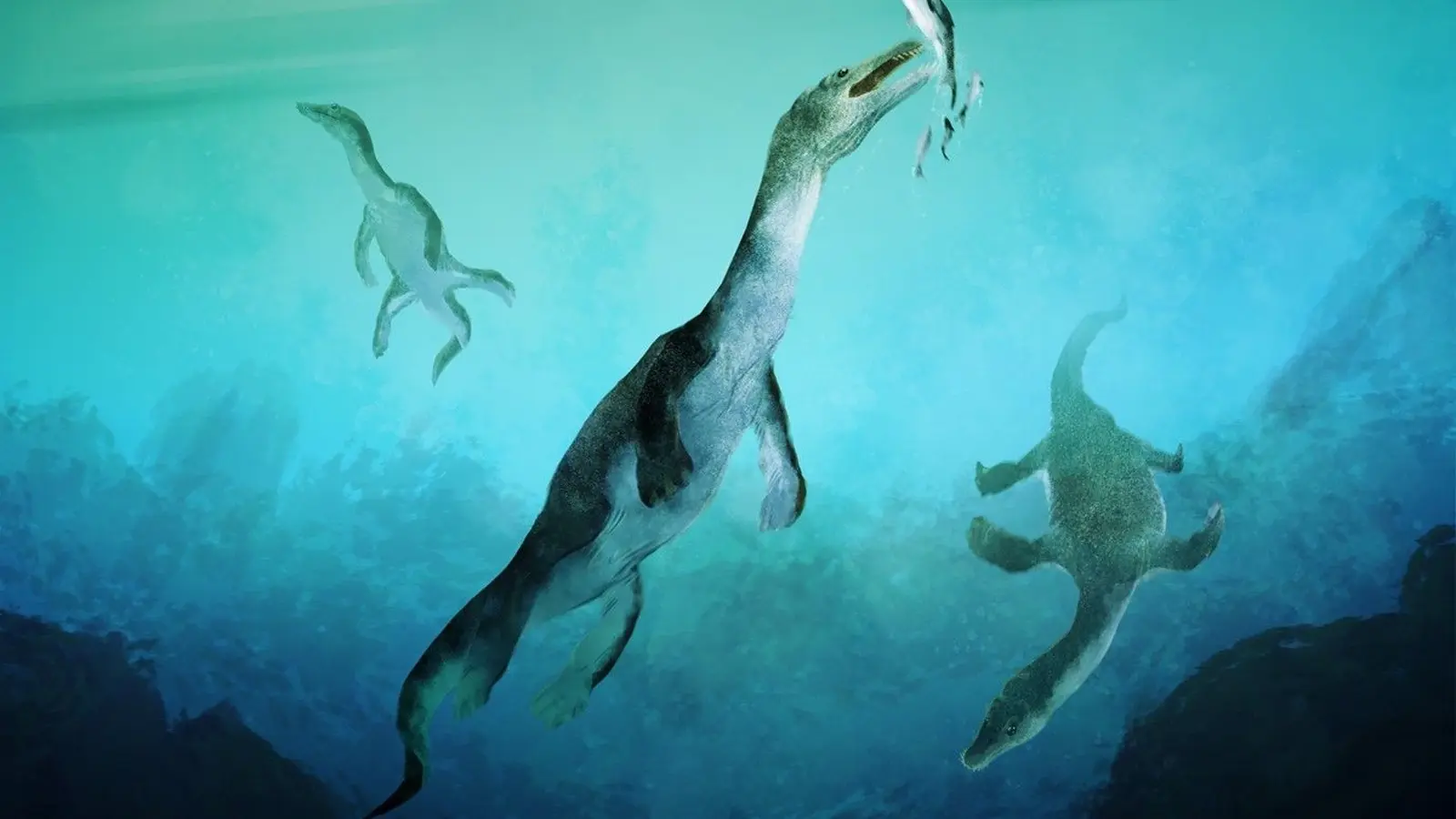
Something like a time capsule washed ashore from deep time: a small, long-necked marine reptile from 245 million years ago with its internal organs still visible in the rock that holds it. That preservation is not a trick of imagination. It is a rare biological snapshot showing stomach, liver and intestines in place—an intact digestive layout from the Triassic that rewrites parts of how we think archosaurs adapted to life in the sea.
A rare window into ancient biology
The specimen belongs to Austronaga minuta, a compact, 60-centimetre reptile with an astoundingly long neck and tail. At first glance its shape echoes other marine forms: a tail that provided thrust in the water; widened, fin-like front limbs for steering and stability; tiny, vestigial hind limbs that barely helped with propulsion. Yet Austronaga is not closely related to ichthyosaurs or mosasaurs. It comes from an archosaur lineage—the same broad family tree that later gave rise to dinosaurs and crocodiles—showing that members of this group were experimenting with fully aquatic lifestyles far earlier and in more varied ways than researchers expected.

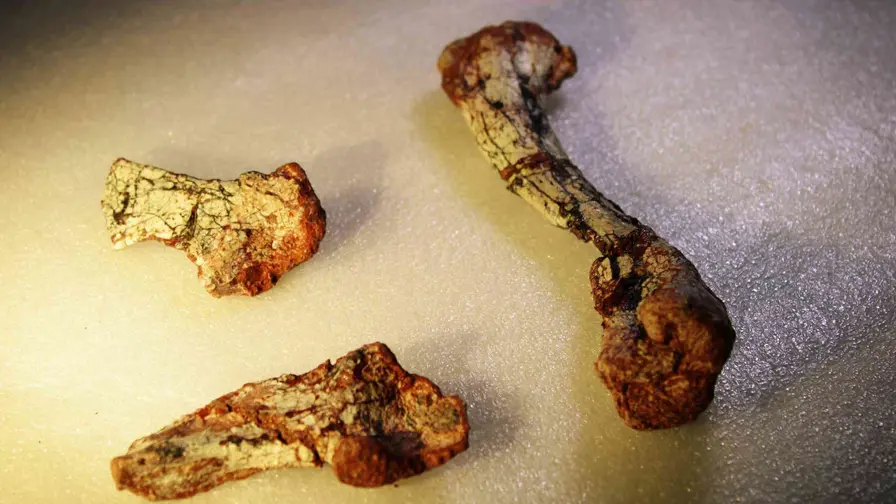
Fossil of the 245-million-year-old marine reptile Austronaga minuta.
Why does this matter? Because soft-tissue preservation from the Triassic is exceedingly scarce. Bones tell one story; organs tell another. Organs reveal diet, digestion, physiology and the pace of an animal’s life. In Austronaga, the preserved organs show a surprisingly simple digestive system, more similar to modern fish-eating reptiles than to the two-chambered stomach we see in birds and crocodilians today.
How scientists read an ancient gut
Finding a dark patch between the ribs prompted detailed analysis. Teams from China, Europe and the United States—led by experts including Dr Stephan Spiekman and Dr Wei Wang—applied ultraviolet light photography and mass spectrometry to separate subtle chemical signatures preserved in the rock. Different tissues leave different molecular fingerprints: remnants of hemoglobin in the liver, mineralized charges in stomach lining, distinct textures along intestinal tracts. These techniques are not new individually, but combined here they give a surprisingly full internal map.
The picture that emerged is clear. At the front sits a large, sac-like stomach. Behind it lies a liver where traces of blood-related molecules can still be detected. A long, simple tube runs posteriorly, forming what would have been the small and large intestines. Put together, the arrangement suggests Austronaga had a short, efficient digestive tract adapted for a carnivorous, likely fish-based diet.
This discovery pushes the earliest record of a largely complete reptile digestive system back to the Triassic. It also indicates that archosaur stomachs began as a single chamber and only later diversified into the multi-part stomachs known in their descendants. In practical terms, a simpler gut would speed digestion and reduce weight—advantages for an animal returning to the water.
Implications for Triassic seas and evolution
Triassic coastal seas were teeming with evolutionary experiments—forms testing the waters, so to speak. Austronaga is one more demonstration that similar body plans evolved in parallel across disparate branches of the reptile family tree. Convergent evolution produced long necks, tail-driven swimming, and limb modifications in lineages that did not share a recent aquatic ancestor. Those repeated solutions tell paleontologists something crucial about constraints and opportunities in marine ecosystems.

Beyond morphology, the preserved internal organs provide direct clues about physiology. A short, uncomplicated intestine matches a diet of easily digestible prey; a single-chamber stomach aligns with a fish-eating lifestyle and suggests more complex stomach division evolved later in archosaur history. Each of these anatomical details feeds into broader questions about metabolism, buoyancy control and how quickly early marine reptiles could grow and reproduce.
Expert Insight
"Finding soft tissues at this age is like getting a page from the animal’s own handbook," says Dr. Alina Cortez, a vertebrate paleobiologist at a European research institute who was not part of the study. "Skeletal anatomy gives you the skeleton of a behavior; preserved organs tell you how that animal processed energy, and that changes your interpretation of its ecology. Austronaga shows us how flexible archosaurs were in the Triassic—experimenters rather than one-trick specialists."
Conclusion
This fossil, now housed in Beijing, is more than a curiosity. It is a data-rich specimen that connects anatomy to function and evolution. By combining fine-scale chemical analysis with careful anatomical interpretation, researchers have extracted a biological narrative from stone: a small marine reptile that returned to the sea, kept a surprisingly simple gut, and thrived in a world rebuilding after mass extinction. Future finds, and the same analytical toolkit applied elsewhere, could further clarify how ancient reptiles diversified and how their internal biology matched changing ecological demands.

“My work centers on sustainability, energy, and environmental science — examining how innovation can lead to a greener future.”

Discussion
Leave a Comment
Comments (2)
Is this for real? chemical traces sound fancy but could be contamination, or am i missing something, if that's real then.. wow
wow, a gut fossil? mind blown. like a time machine but real. organs preserved, no way... how did that even happen, science!!