
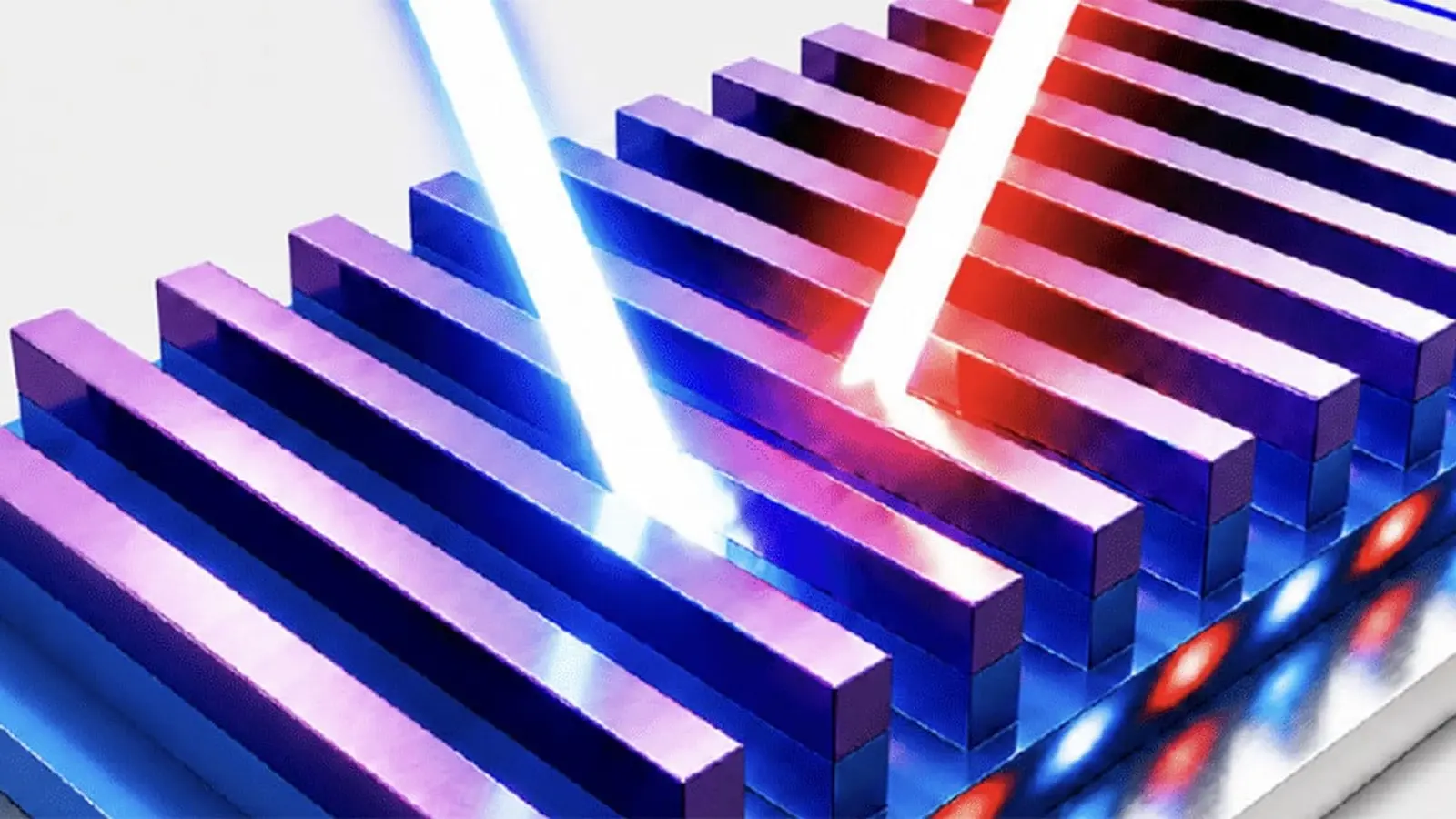
Imagine a surface that lets heat pass one way but blocks it the other. Not by clever insulation, but by design: guiding infrared radiation like traffic on a one-way street. That is the promise of a new theoretical device that bends a 160-year-old rule in physics and stores thermal settings even after the power is cut.
How the device flips heat's rules
Kirchhoff's law, formulated in the 19th century, ties absorption and emission of radiation together. If a material strongly absorbs heat from a given direction, it must also emit heat back along that same direction. Engineers have long felt hemmed in by that reciprocity: it limits how independently systems can absorb incoming heat and shed outgoing heat.
Researchers now propose a layered structure that breaks this reciprocity for thermal radiation. The trick is not magic; it is about pairing two materials that do not normally cooperate. The bottom layer is indium arsenide, a semiconductor that interacts strongly with infrared radiation. Apply a magnetic field to this layer and you break its natural symmetry. Heat traveling one way then behaves differently than heat traveling the opposite way. Physicists call this magneto-optical nonreciprocity.
On top of that sits a phase-change crystalline film made from a germanium-antimony-telluride compound (GST). GST can switch between two very different physical states and, crucially, it remembers its state without power. In other words, the phase layer acts like a thermal memory: once you program it to favor a particular directional behavior, it locks that behavior in place even after you remove the external field.
Put together, the magnetically biased indium arsenide creates directional differences in how infrared radiation travels, and the GST film stores and stabilizes those differences. The result: a theoretical device that preferentially absorbs radiation from one side while emitting it primarily to another, violating the simple reciprocity implied by Kirchhoff's law for ordinary passive materials.

Why this matters: practical gains and real constraints
At first glance, this looks like academic elegance. But the implications are tangible. Consider solar panels. Today, part of incoming sunlight is reflected or re-emitted and lost. A surface that selectively traps incoming radiation from the sun while diverting emissions elsewhere could extract more usable energy from the same incoming flux. In short: fewer losses, more conversion efficiency.
Or take electronics. Modern circuit boards cram ever more components into tight spaces. Heat management becomes a limiting factor for performance and reliability. A nonreciprocal thermal layer would let engineers steer waste heat away from sensitive parts without heating nearby components. Components could sit closer together and still avoid thermal cross-talk.
Another immediate application lies in infrared sensing. Thermal cameras and face-detection systems struggle when unwanted heat sources bleed into the detector field. A detector that only accepts thermal radiation from a preferred direction would reduce background noise and sharpen images. That could improve both resolution and reliability for thermal diagnostics.
- Energy systems: higher solar conversion efficiency via directional absorption.
- Thermal management: targeted heat routing in dense electronics.
- Infrared sensors: directional selectivity for cleaner thermal images.
Yet the device has limits. It remains theoretical; no working prototype has been built by the team. The researchers argue that current materials and fabrication techniques are sufficient to realize the design, but hurdles remain. Chief among them is the thickness of the GST layer required in the proposed stacks. That thickness makes switching between states slow and energetically costly, which would hamper repeated reprogramming of the thermal response. In short: excellent for a memory-style setting, less practical for rapid toggling.
There is another technical advantage worth underlining. Earlier attempts to make heat nonreciprocal required radiation to skim the surface at grazing angles, near-horizontal incidence, which is impractical for many real-world sources that strike nearly straight on. The new design works well even when incoming radiation deviates only three degrees from normal incidence. That small tolerance opens the door to real applications that do not demand exotic optical setups.
The work appears in the peer-reviewed journal Laser & Photonics Reviews and sketches a path from theory to laboratory tests. The findings sit at the intersection of photonics, solid-state physics, and materials science, and they revive a question with wide technological reach: can thermal energy be routed, stored, and even computed with the same sophistication we give to electrons?
Expert Insight
"This paper is an important step toward practical nonreciprocal thermal devices," says Dr. Elena Varga, a materials physicist not involved in the study. "Breaking reciprocity at infrared wavelengths is difficult because thermal radiation is broadband and incoherent. The strength of this design is that it combines magneto-optical effects with a phase-change memory layer, so you get directionality plus persistence. The next work will need to make the phase layer thinner and faster without sacrificing stability."
Dr. Varga's point highlights a common pattern in translational research: conceptual breakthroughs arrive first; engineering optimizations follow. If suitable thin GST variants or alternative phase-change compounds are found, devices could transition from controlled lab demonstrations to practical sensors, modules in electronics, or hybrid energy surfaces.
Future prospects: thermal memory and computing
Beyond sensing and heat routing, there is a further, bolder possibility: information processing with heat. If materials can store states in thermal form (hot versus cool, or distinct spatial emission patterns), and if those states interact in programmable ways, then logic operations could be encoded thermally. Imagine circuits where bits are patterns of heat instead of voltages. Such thermal computers would not replace digital electronics overnight, but they could offer ultra-low-energy computation in specific contexts, for instance where waste heat is abundant and power distribution is constrained.
That future will require solving speed and endurance constraints of phase-change materials, integrating thermal logic elements, and building architectures tolerant of thermal noise. It will also demand novel design rules for thermal circuits, since heat flows diffusively rather than ballistically like electrons or photons in many settings. Still, the present study points in the direction of those possibilities.
Conclusion

The proposal to override a 160-year-old reciprocity principle is more than theoretical bravado. By combining magnetically biased indium arsenide with a stable phase-change layer, researchers sketch a route to devices that guide infrared radiation asymmetrically and remember that setting without power. If material challenges—primarily the thickness and switching speed of GST—can be overcome, the nearest applications are improved infrared sensors and smarter thermal management in electronics. Farther down the road lies the intriguing idea of thermal computation, where heat itself becomes a carrier of information. For now, the concept is ready for lab tests; the engineering journey has only begun.

“My work centers on sustainability, energy, and environmental science — examining how innovation can lead to a greener future.”

Discussion
Leave a Comment
Comments (3)
Feels overhyped but okay, neat theory. Thermal computing is wild but noise and speed probs kill it for now.
Is this even practical though? GST thickness sounds like a dealbreaker, and how uniform must the magnetic bias be across a whole panel?
Wow this actually flips a 160-year rule? Mind blown. If they can thin out GST and make it fast, game changer... but skeptical.