
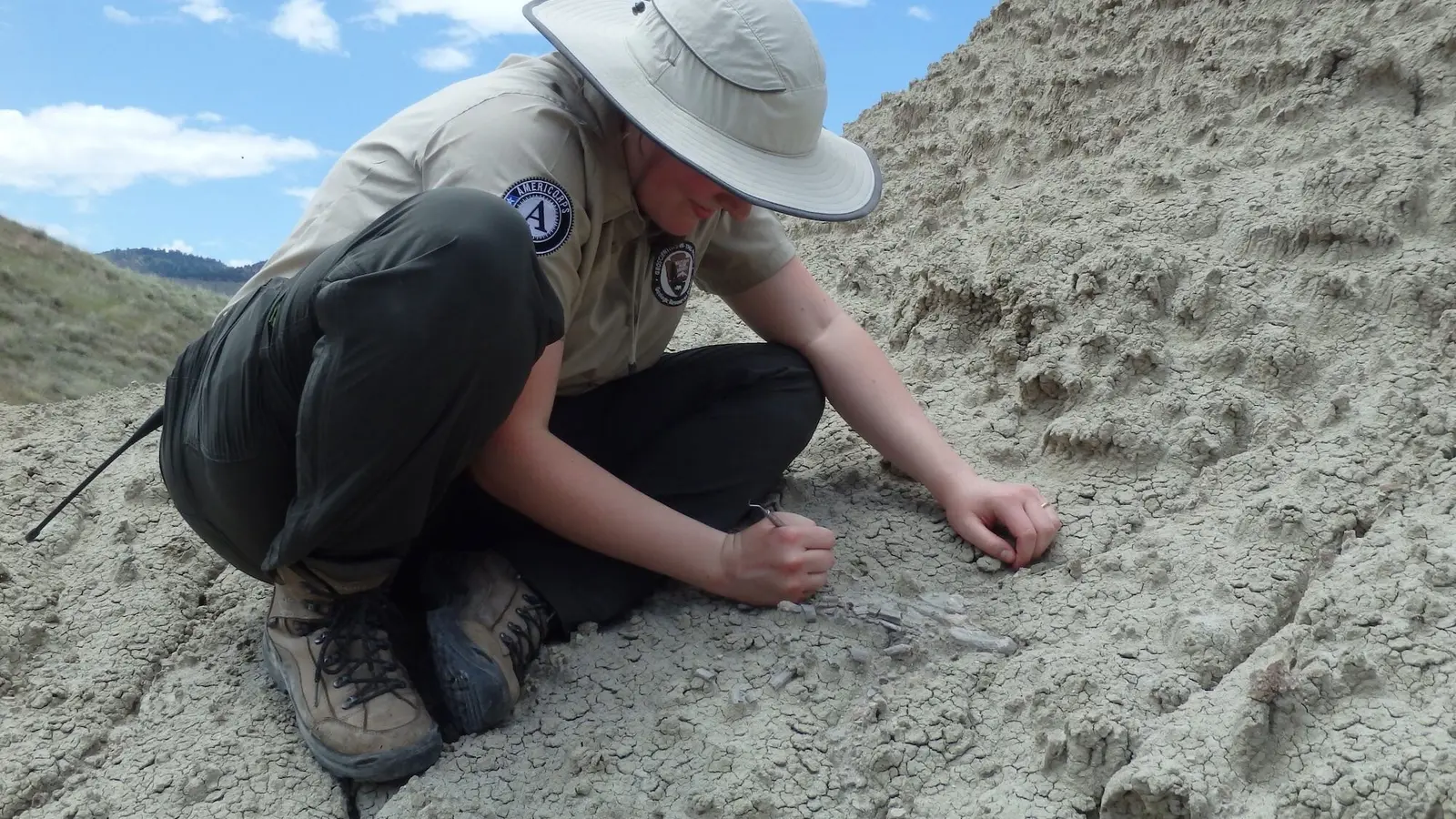
Locked inside a rock-laden block for more than three decades, a nearly complete skeleton lay quiet in an Oregon collection until careful hands and fresh eyes pulled a lost chapter of canine evolution into the light. The fossil is not what early collectors expected. It is a dog that did not run like modern canids. It could climb.
A surprising identity in the museum vault
When field crews first recovered the block in the late 1980s near the John Day Fossil Beds National Monument, the specimen looked familiar enough to be misfiled. The bones suggested an oreodont, a stocky extinct herbivore once common across North America. That initial judgment stuck for years. Then researchers removed the skull for display and the skull said something different. This was a canid.
More than 30 million years old, the animal belongs to Mesocyon coryphaeus, a species named in 1879 but until now known mainly from isolated skulls. University of Michigan paleontologist Anne Kort examined the whole animal for a special Journal of Paleontology issue marking the 50th anniversary of the John Day Fossil Beds National Monument. The result is one of the most complete pre-Ice Age dog skeletons ever found on the continent.

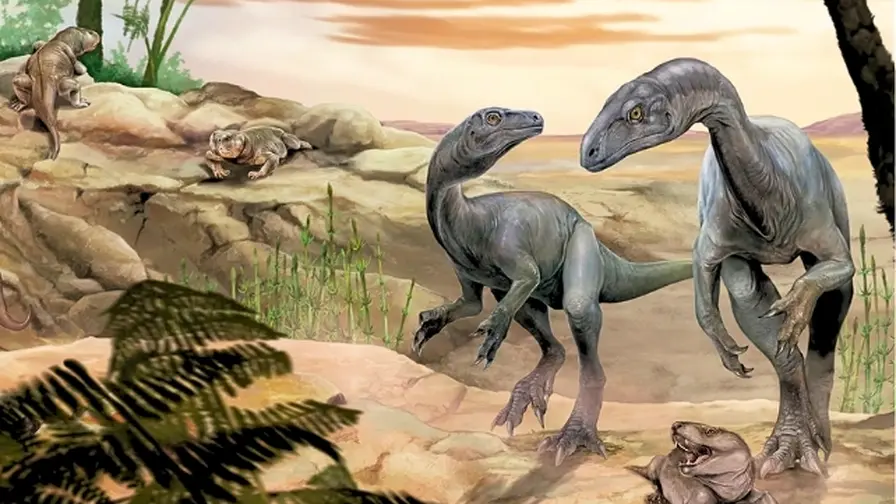
Kaori Chambers, University of Michigan graduate student in ecology and evolutionary biology, created an artistic representation of Mesocyon coryphaeus. U-M paleontologist Anne Kort identified a fossil as one of the most complete Mesocyon coryphaeus specimens found yet. The specimen was a fossil dog the size of a coyote.
What the skeleton reveals about behavior and body plan
Complete skeletons are rare and, when they appear, they tell stories bones alone rarely do. This Mesocyon preserves nearly everything except parts of the tail and bits of the hands and feet. Those missing pieces matter less because what remains is vivid: a stockier, shorter-limbed canid that retains anatomical features we associate with climbing and grappling rather than sustained running.
The elbow joint is not shaped for high-speed pursuit. It allows a degree of forearm rotation that modern running dogs lack. The first digit is large, much like a dewclaw on today’s dogs, and the limb proportions suggest Mesocyon could place its heel periodically on the ground instead of walking exclusively on its toes. Put simply: this animal had not specialized for cursorial life.

University of Michigan paleontologist Anne Kort identified a fossil as one of the most complete Mesocyon coryphaeus specimens found yet. The specimen, a fossil dog the size of a coyote, had an elbow joint suggesting it could climb and grapple, according to Kort.
An inherited marker: the osteochondroma
One of the clearest lines of evidence tying the skeleton to early dogs is the presence of an osteochondroma, a hereditary bony growth at the end of the wrist. That pathologic sign appears in roughly 60 percent of the earliest recognized dog fossils. It is a small but persuasive clue that strengthens the identification beyond skull shape and dentition.
And there is another personal detail. The specimen retains a baculum, the penile bone, which allowed researchers to determine the animal was male without guessing from ambiguous skeletal traits. Small things like that make a big difference in reconstructing life histories and population structures in deep time.
Why this Mesocyon matters for canine evolution
Dogs trace their origins to North America nearly 40 million years ago. Their common ancestor, Hesperocyon, likely lived in densely forested landscapes and, by many accounts, could climb. As climates cooled and forests gave way to open woodlands and grasslands roughly 10 million years later, many canine lineages evolved toward speed and endurance. Limbs lengthened. Elbows locked more rigidly. Foot postures shifted toward toe-only walking, a pattern that improves running efficiency.
Mesocyon sits in this transitionary interval. It demonstrates that not all canids followed the same path. Here, the body plan retained climbing-friendly traits even as the world moved toward more open habitats. The species was coyote-sized yet compact. Robust bones. Strong forelimbs built for manipulation and possibly arboreal movement. The picture is of a dog ecology we no longer see.

A fossil of Mesocyon coryphaeus was found on Bureau of Land Management land in the 1980s, near the John Day Fossil Beds National Monument.
That absence is more than curiosity. Extinction erases not only species but the ecological roles they filled. When a lineage vanishes, its combination of behaviors, habitats, and morphologies vanishes with it. Evolution does not produce exact replacements. It produces workable solutions. Mesocyon represents a workable solution that was lost.
Scientific context and implications
The skeleton offers data points that matter to several research threads: the tempo of locomotor adaptation in canids, morphological plasticity in response to habitat change, and the frequency and impact of hereditary pathologies in early mammal populations. For paleoecologists, Mesocyon provides a snapshot of an animal that straddled forest and woodland niches. For evolutionary biologists, it is a reminder that ancestral traits can persist longer and in more diverse combinations than linear narratives often imply.
Prior to Kort’s work on this specimen, Mesocyon had been a ghost of skull fragments and partial jaws. With postcranial material now available, researchers can run biomechanical models, test hypotheses about foot posture and gait, and compare limb bone cross-sections to infer activity levels and stress patterns. This is the kind of fossil that transforms questions into quantifiable analyses.

University of Michigan paleontologist Anne Kort identified a fossil as one of the most complete Mesocyon coryphaeus specimens found yet. Kort said the dog, which was about the size of a coyote, likely at least occasionally walked from heel to toe and was not adapted for running, whereas modern dogs walk on their tip toes and are adapted for running.
Expert Insight
"Complete specimens like this one are rare windows into functional morphology," says Dr. Laura Mendes, a vertebrate paleontologist not involved with the study. "One missing skeleton can skew our view of an entire clade. This Mesocyon helps correct that bias. It reminds us that early canid evolution was experimental. Some branches ran, others climbed. Both approaches suited their environments for a time."
The quote underscores how a single find reshapes assumptions. It also points toward future work. More fieldwork in the John Day region and new reexaminations of museum collections could reveal additional Mesocyon individuals or related forms. Each specimen would refine a picture that is still incomplete.
Conclusion
This fossil is at once an anatomical puzzle and a message about loss. Mesocyon coryphaeus is not a direct ancestor of modern dogs. Its lineage ended. But the animal’s body preserves strategies not present among living canids. That matters for how we think about adaptability, specialization, and the finality of extinction. Once a unique ecological role disappears, it is unlikely to return in the same form.
Practical next steps are clear. Researchers will integrate limb measurements from this specimen into comparative datasets, model locomotor capacities, and search archives for similarly misidentified blocks of fossil-bearing rock. Museums hold many such surprises. This time, a fortunate combination of preservation and curiosity let paleontologists read a lost canine story from preserved bone.
JODA paleontologist Ted Fremd originally found the fossil, made its recovery a priority, and completed the first preparation work that exposed the skull. JODA paleontologist Joshua Samuels assigned Cavin to remove the remaining skeleton from its protective jacket in 2011. Nicholas Famoso, now the chief paleontologist at JODA, later proposed that Kort study the specimen. Xiaoming Wang of the Natural History Museum of Los Angeles County is also a coauthor of the research.

“My work centers on sustainability, energy, and environmental science — examining how innovation can lead to a greener future.”

Discussion
Leave a Comment
Comments (3)
Cool find but feels a bit dramatic to call it 'lost chapter' lots of gaps still. Still, great to get postcranial data, if they'd only dig up more...
Is the osteochondroma enough to ID it? skull+pathology is suggestive but I wanna see stats, sample size etc. more fossils pls
wow mesocyon could climb? that image of a coyote-sized tree dog is wild... makes me rethink early canid life, honestly