
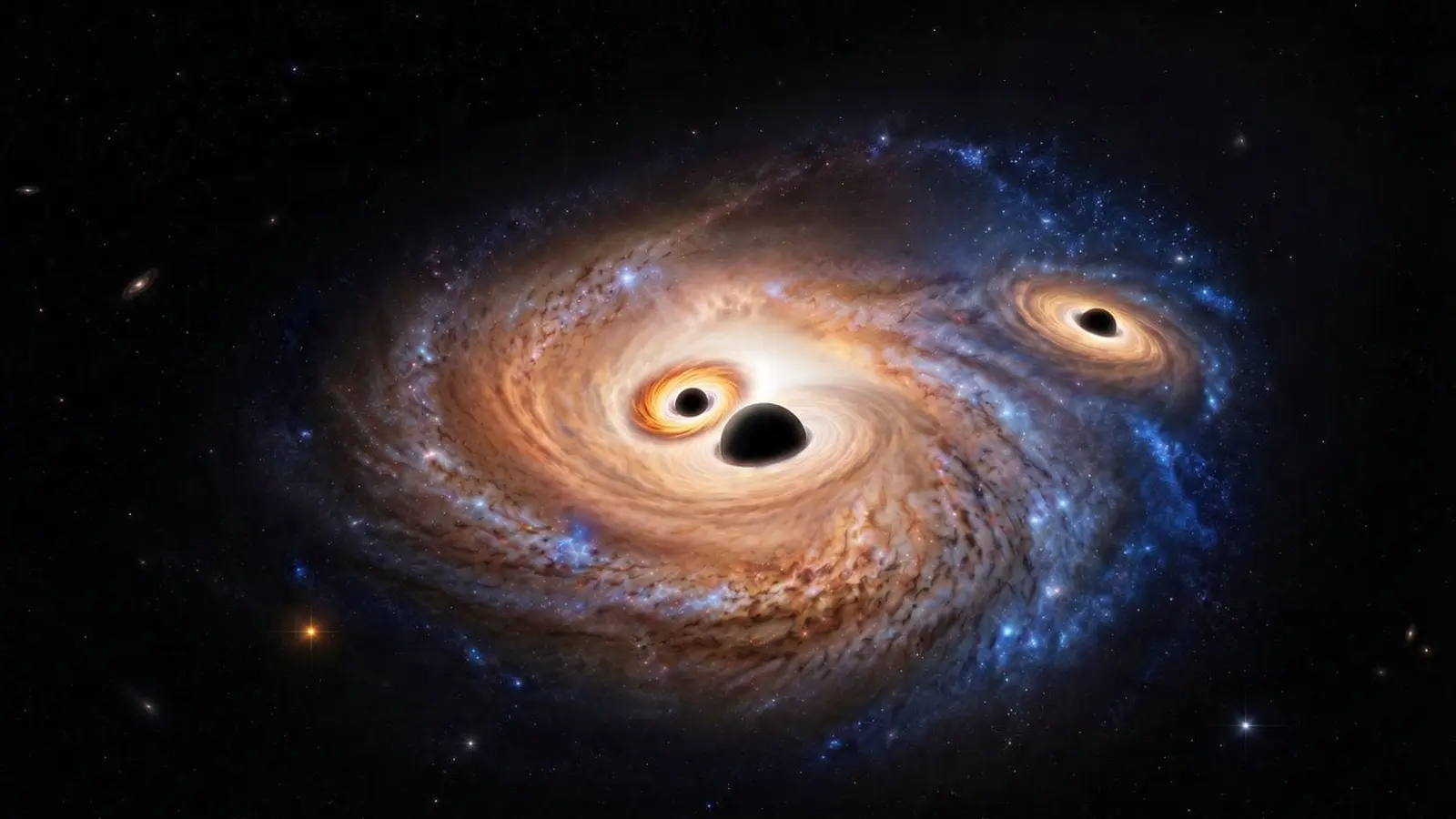
An image from the edge of time: light that left a galaxy more than 12.5 billion years ago has just reached us, and hidden inside is a startling discovery. Astronomers have identified three actively feeding supermassive black holes in a single, very distant galaxy, offering a rare window into how black holes grew and combined when the cosmos was still young.
A crowded center in a 1.2-billion-year-old universe
The galaxy, catalogued as J0148-4214, sits at a redshift of z = 5.02. In human terms that means we are seeing the system as it appeared roughly 1.2 billion years after the Big Bang. At that epoch, galaxies were still assembling, colliding, and reshaping themselves. The team led by researchers at the Max Planck Institute for Extraterrestrial Physics used the James Webb Space Telescope to peer into this ancient object and found not one but three black holes actively accreting gas.
Two of the black holes huddle near the galaxy center. Projected on the sky, they are only about 620 light-years apart, close enough that their mutual gravitational pull will likely drive them toward a merger over the next few hundred million years. The third sits much farther out, roughly 5,500 light-years from the center, a loner that raises immediate questions about its past and future.
How astronomers teased out three signals
Finding multiple active black holes in a single distant galaxy is not easy. At these distances, even JWST cannot always resolve separate point sources. The discovery relied on spectral fingerprints, especially hydrogen emission lines that betray extreme velocities. The central spectrum was complex, and the team used spectro-astrometry to measure tiny spatial shifts in emission lines across the galaxy, a technique that reveals sub-resolution structure by tracking how the centroid of light changes with wavelength.
That analysis separated the blended central emission into two distinct accreting black holes. A third active nucleus emerged from spatially resolved data in the galaxy outskirts. From the spectral shapes and luminosities the researchers estimated black hole masses near 80 million, 2 million, and 0.6 million times the mass of the Sun. Counterintuitively, the smallest of the three appears to be feeding fastest, accreting above the classical Eddington limit that many simple growth models assume as a cap.
"This is the first evidence of three active black holes in a single galaxy in the distant Universe," said Hannah Ubler, lead author and research group leader at MPE. She added that the result suggests early cosmic environments were efficient at gathering massive black holes, paving the way for the kinds of mergers gravitational wave observatories will seek in the future.

Map of the distant galaxy J0148-4214 in ionized hydrogen (Hα). The locations of the three massive black holes are indicated by black circles (not to scale). The most massive and least massive black holes are located in the galaxy center; a third black hole is located in the galaxy outskirts.
Why this matters for black hole growth and gravitational waves
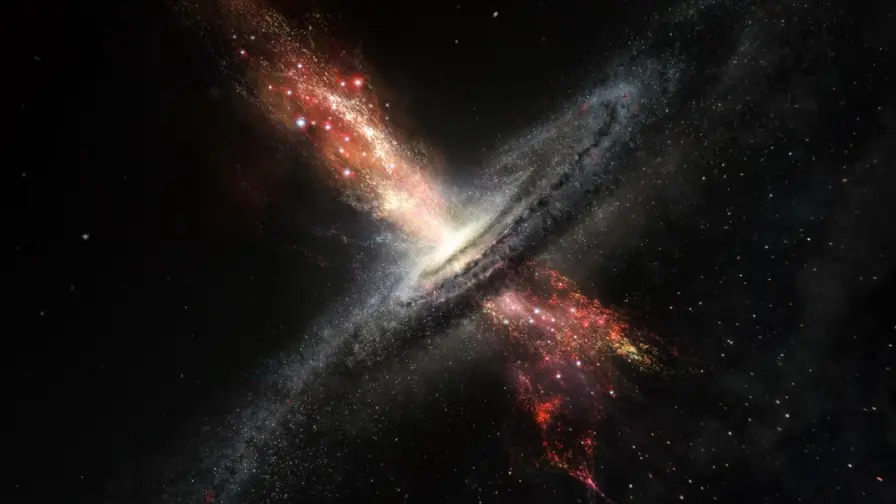
Galaxy mergers are a core part of hierarchical structure formation, the picture in which small systems combine to build larger ones. When galaxies merge, their central black holes are brought into the same neighborhood and can eventually coalesce, producing more massive black holes and releasing energy as gravitational waves. Observing multiple active nuclei inside a single high-redshift galaxy provides empirical support for this channel of rapid growth in the early universe.
Dr. Giovanni Mazzolari, a co-author and researcher at MPE, emphasized that JWST data allowed the team to go beyond mere detection. By combining spectral and spatial information they could estimate not only black hole masses and accretion rates, but also the host galaxy stellar mass, which they place at about 1.3 billion solar masses. In that context, the black holes represent a substantial fraction of the galaxy mass, reinforcing how influential active nuclei were in shaping young galaxies.
Roberto Maiolino, a co-author and professor at the University of Cambridge, noted that mergers may provide a fast track to build the supermassive black holes we observe at high redshift. If two of the central objects merge within a few hundred million years, the remnant could leap in mass and alter the galaxy's evolution, including star formation and gas dynamics.
Expert Insight
"Discoveries like this change how we think about early black hole demographics," said Dr. Leila Moreno, a fictional astrophysicist who studies compact object populations. "Seeing multiple active nuclei in one ancient galaxy implies the conditions for rapid growth were already in place very early on. It also tells us to expect a rich signal of black hole mergers when space-based gravitational wave observatories come online."
Beyond the headline, the observational technique matters. Spectro-imaging instruments that deliver spatially resolved spectroscopy, such as JWST NIRSpec-IFS, are uniquely suited to find hidden companions in crowded, distant systems. Without that spatial information, astronomers might have labeled J0148-4214 as a single active nucleus and missed the dynamics at play.
Implications and next steps
Several open questions remain. Is the off-center black hole a remnant displaced by a gravitational recoil after a previous merger, or is it still spiraling inward following a more recent galactic encounter? How common are triple active nuclei at high redshift, and what fraction lead to sequential mergers that can build billion-solar-mass black holes within a few hundred million years?
Future observations can expand the sample, explore the host galaxy environment in more detail, and follow up with simulations that include gas dynamics and gravitational recoil. Combined with upcoming gravitational wave facilities and more deep-field JWST surveys, systems like J0148-4214 will help close the gap between theoretical models and what the universe actually did in its first billion years.
Conclusion
The detection of three supermassive black holes actively feeding inside a single galaxy from the dawn of the universe is a striking piece of evidence. It underlines how complex and dynamic early galaxy assembly could be, and it points to mergers as a plausible, rapid pathway for black hole growth. As observational capabilities improve, we should expect more surprises from the cosmos at high redshift.

“The cosmos has always fascinated me. I write about space missions, astronomy, and the technologies pushing humanity beyond Earth.”

Discussion
Leave a Comment
Comments (3)
Feels kinda overhyped but still cool. How common are triples though? selection bias, luminosity limits, tiny sample. Quick comment, wanna see the stats
Is the spectro-astrometry really resolving that cleanly? at z=5 projection effects and line blending worry me. Need independent confirmation, like ALMA or deeper JWST
wow, three feeding giants in one baby galaxy? mind blown. The idea of a 0.6M BH out-eating an 80M one is wild, if true this could rewrite early growth ideas