
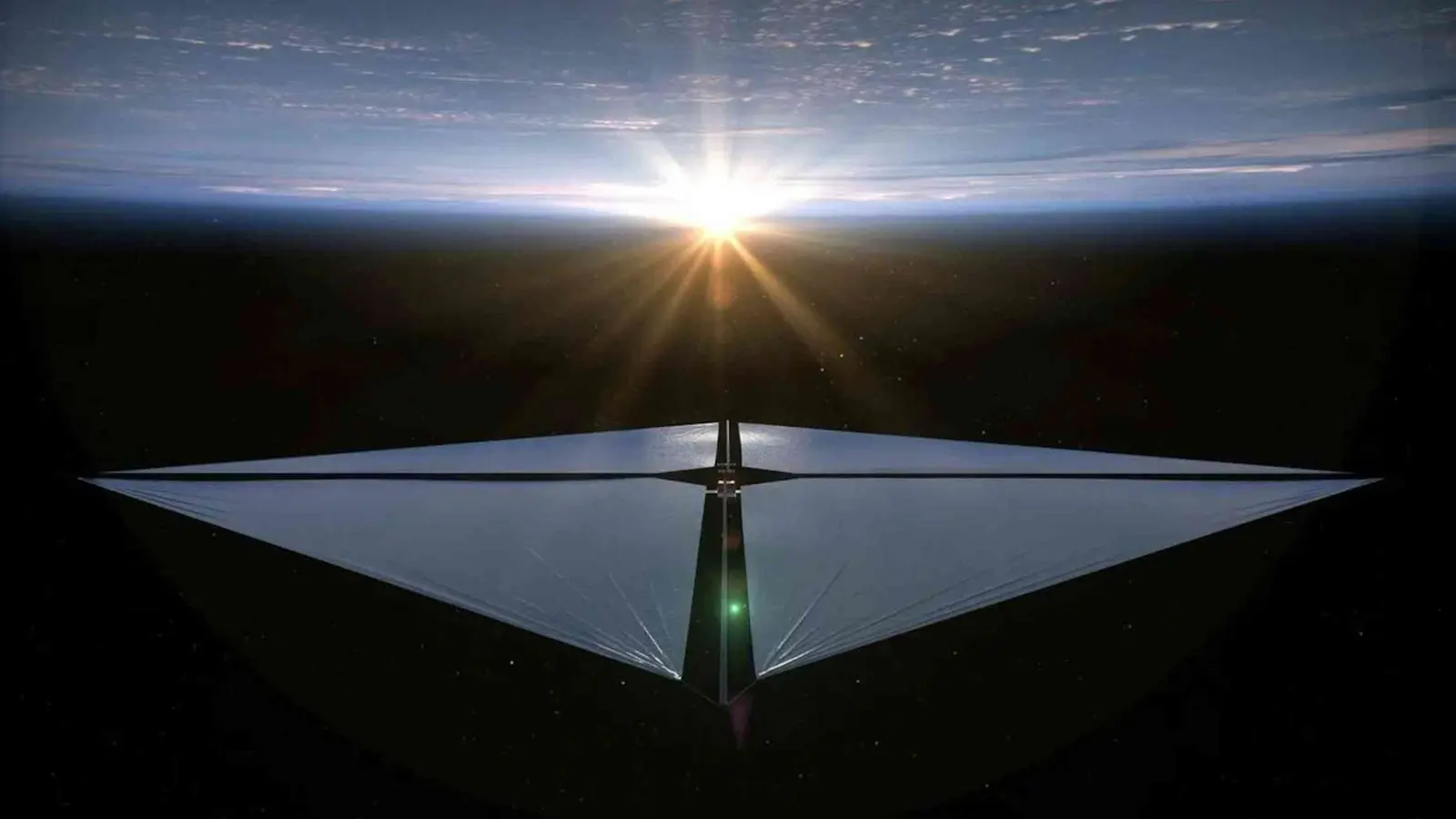
Imagine a wafer-thin mirror no bigger than a sheet of paper, pushed by a column of light until it slips the bonds of the Solar System and races outward at a tenth of the speed of light. That is not a movie scene. It is a concrete engineering path now being sketched by physicists, engineers and entrepreneurs who want to send microprobes to other star systems within a human lifetime.
Tiny probes, big gains
Why go small? Because mass is the enemy of speed. The less a vehicle weighs, the less energy required to accelerate it to a fraction of light speed. Modern electronics have made it realistic to imagine suites of sensors that weigh only grams yet can measure magnetic fields, take images and analyze spectra. Think smartphone cameras shrunk further, and sensors known as smart dust that can detect light, temperature and chemical signatures at millimeter scale. Pack a few of those into a centimeter-class payload, add a communications laser and some basic autonomy, and you have a candidate probe for interstellar flight.
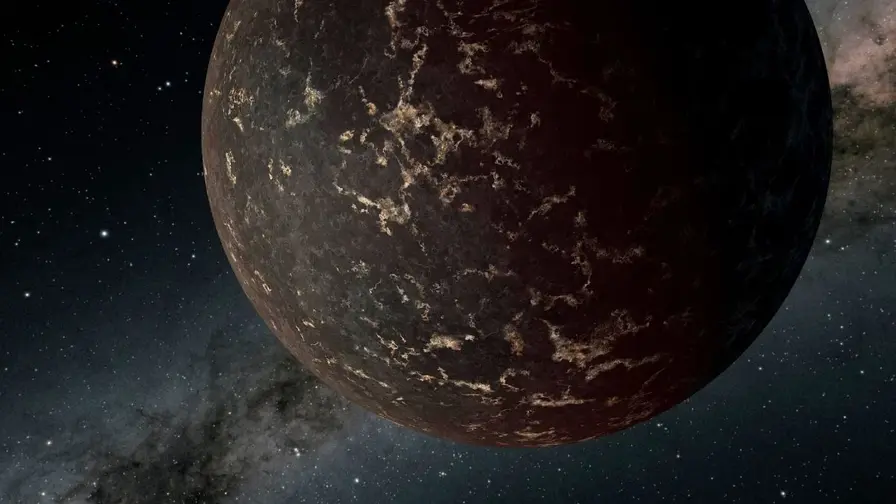
Interest in nearby rocky worlds has sharpened the case for such missions. Take LHS 1140b, a rocky planet orbiting a red dwarf about 48 light-years away. Recent observations detected helium being lost from its upper atmosphere, a sign that atmospheric escape processes are active. That same detection leaves open the possibility that heavier molecules like water remain deeper in the atmosphere, shielded from the star. Telescopes can give us spectral hints. A flyby probe could read the atmospheric layers directly, with time-resolved measurements during a brief passage.

In this artist’s concept, the exoplanet LHS 1140 b is shown in the foreground, surrounded by a helium-rich atmosphere.
Sending a large, crewed ship to another star remains beyond foreseeable technology. But a fleet of tiny, inexpensive probes changes the equation. If each probe costs a small fraction of a planetary mission, a program can afford redundancy: hundreds or thousands of scouts launched in waves. One arrives. It sends back a few kilobytes. That still beats decades of speculative modeling.
How light sails turn photons into push
Light carries momentum. When photons bounce off a reflective surface they impart a tiny push. For everyday objects that push is negligible. For a membrane engineered to be extremely light and highly reflective, and for an intense beam of light focused on it, the accumulated pressure becomes meaningful.
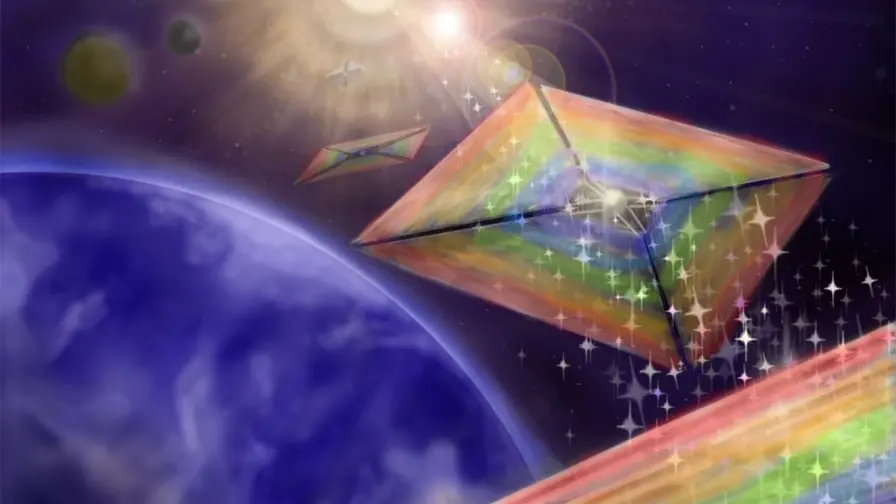
There are two practical ways to harness that pressure. The first is passive: let sunlight do the work. Solar sails have already flown. They require no propellant and can change orbital energy by angling the sail relative to the incoming photons, much like a ship tacking under wind. The second method uses directed energy. An array of ground or orbital lasers fires a coherent beam that tracks a sail for minutes. With enough power, that beam can accelerate a gram-scale spacecraft to tens of percent of the speed of light in a short burst.
For the directed-energy route, engineers estimate laser arrays with effective output in the tens of gigawatts would be needed to push a sail of a few meters across to 0.1 to 0.2 times light speed. That is a significant technical challenge. Such a system would likely be modular: many smaller lasers phased together to form a coherent beam. The advantage is clear: the laser infrastructure stays at home while the tiny payload rides the light to the stars. The disadvantage is equally stark: once the probe reaches cruising speed it cannot decelerate using the same beam. It will fly through the destination system in a matter of days and then continue on.

Engineers at NASA’s Langley Research Center inspect a solar sail. The unfurled sail is approximately 30 feet (about nine meters) on one of its sides.
That limitation has shaped mission concepts. Many designs imagine a brief, intense encounter: collect images, perform spectroscopy, measure magnetic fields and particle fluxes during a fast transit, then beam compressed data home at optical frequencies. The data return would be slow and low in volume, but the scientific value of an in situ measurement of an exoplanetary atmosphere could be enormous.
Practical steps today
We do not need to wait for a space-age laser farm to begin reaping the benefits of sail technologies. Solar sails are operational now as technology demonstrators and as mission enablers inside the Solar System. Because they do not carry propellant, they can pursue trajectories that would be prohibitive for conventional chemical rockets. They can reach high-energy orbits, intercept long-period comets on unusual inclinations, and even perform challenging sample-return maneuvers without hauling the massive fuel fractions that otherwise make such missions impractical.
Solar sails also offer novel stationkeeping options. By balancing sunlight and gravity, a sail can maintain positions that are not possible for ordinary spacecraft. It could hover above a planetary pole or hold a quasi-stationary point to provide long-term observations of a target. These capabilities make sails attractive for both science and operations demonstrations that build confidence for larger initiatives.
Expert Insight
Dr. Elena Ramos, an astrophysicist involved with advanced propulsion studies, summarizes the practical appeal: "We are at a point where the physics and the component technologies are converging. Miniaturized instruments and improved photonics mean a single gram-scale probe can perform measurements that, a decade ago, required far heavier hardware. The directed-energy infrastructure is the big engineering hurdle, but the incremental benefits from solar sail missions within the Solar System give us a practical stepping-stone toward that bolder vision."
The voice of an engineer is just as blunt. "Scaling is the key," says Mark Albright, a systems engineer who has worked on sail prototypes. "If you can halve mass, you square the possible destinations for the same laser budget. That creates an economy of scale for science missions."
What a visit would look like
Picture a tiny probe approaching a red dwarf system at 0.15c. The onboard instruments awaken on approach, stabilize, and point a miniature spectrograph at the target planet as the probe sweeps past. Ionized gases in the upper atmosphere glow under stellar irradiation. A spectrometer samples lines that reveal helium loss, molecular composition and perhaps the presence of heavier species lower down. High-resolution images show cloud patterns and surface contrasts if the geometry permits. Then the probe turns its laser transmitter toward Earth and begins the long, low-rate task of sending home what it learned.
That narrative highlights the interplay between autonomy, communications and mission design. The probe must run complex sequences without real-time human control. It must compress and prioritize data. And it must survive decades of interstellar travel in a harsh radiation environment. Each of those requirements is a target for research now.
Looking forward
Directed-energy light sails and solar sails are not mutually exclusive. The nearer-term payoff will likely come from solar sail missions that test advanced materials, sailing strategies and long-duration autonomy. These missions will refine navigation while our telescopes continue identifying promising exoplanetary targets. Concurrently, laboratory and prototype work on phased laser arrays, precision optics and lightweight reflectors will chip away at the larger challenge: building a beam system capable of imparting relativistic speeds.
If successful, the payoff would be profound. For the first time, humanity would have a practical means to send instruments to other stars and obtain direct measurements from exoplanetary environments. The payloads will be small and data sparse compared to planetary probes in our own system, but they will be the first footsteps of an observational capacity that stretches across light years.
Conclusion
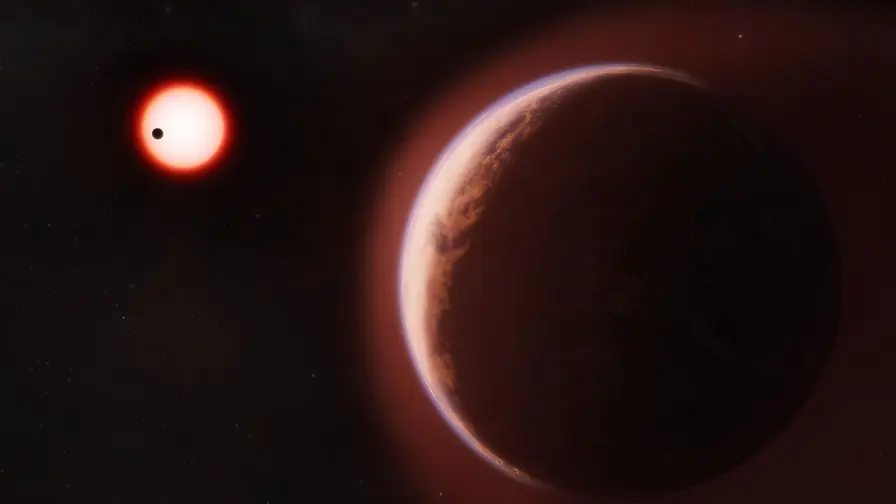
The dream of visiting another star with an engineered object is moving from fanciful to feasible. Miniaturized probes riding photon winds offer a pragmatic route: begin with solar sail demonstrations, mature directed-energy technologies, and deploy swarms of microprobes to high-value exoplanet targets identified by telescopes. The path is difficult, but it is rooted in established physics and evolving engineering. Someday soon, a sliver of metal pushed by light could give us our first close look at an alien world.

“The cosmos has always fascinated me. I write about space missions, astronomy, and the technologies pushing humanity beyond Earth.”

Discussion
Leave a Comment
Comments (3)
Nice vision but feels overhyped. Building a tens-of-gigawatt laser farm? huge logistics, politics, funding. Still cool tho, if it works.
Wait, if they cant decelerate won't it just zip past? How do they expect meaningful data w/ a few kilobytes and decades delay? feels optimistic to me.
wow this gave me goosebumps, tiny mirrors pushed by light!? the idea of paper-thin scouts to LHS1140b is wild. so much future potential