
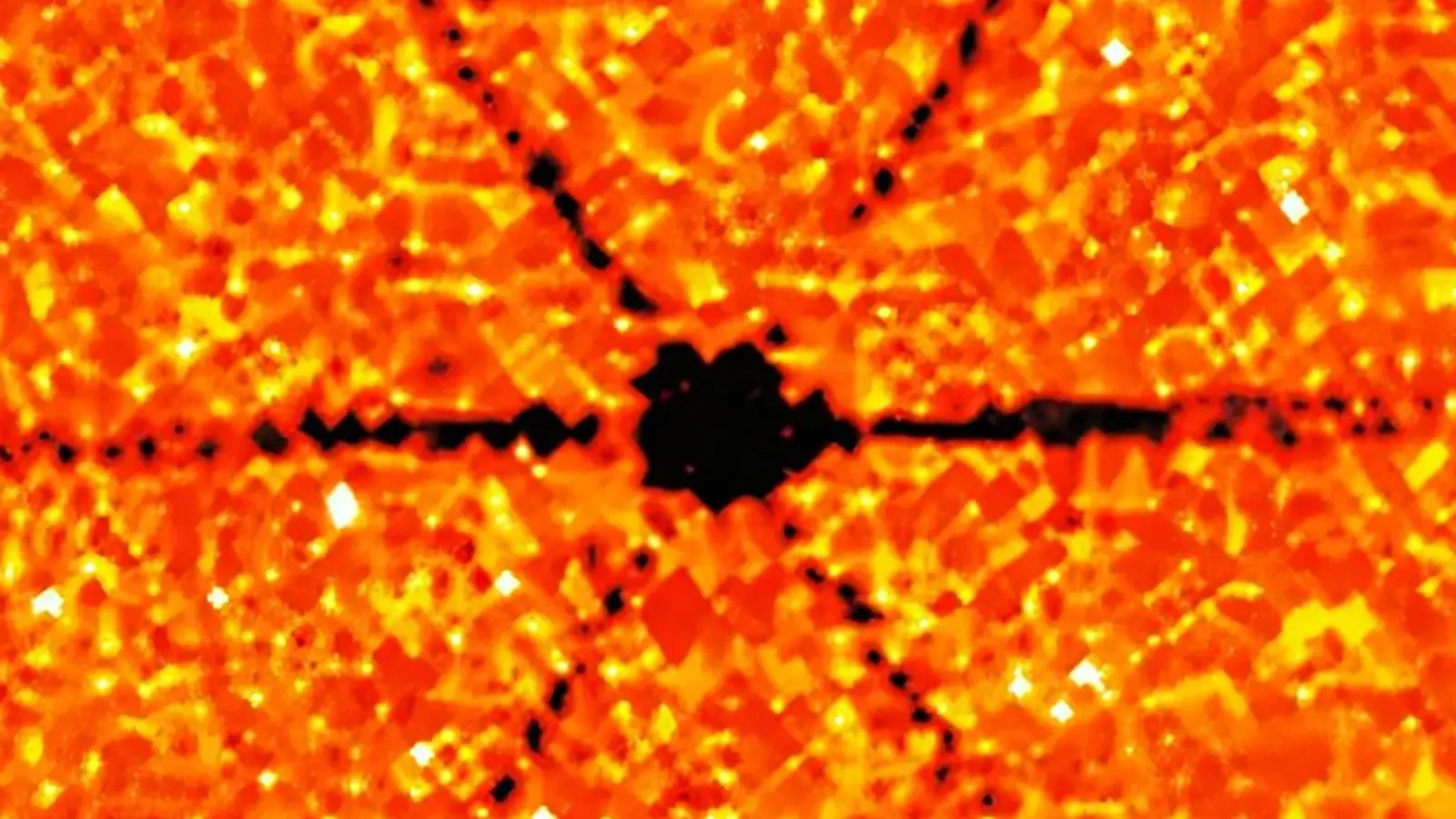
Imagine heat moving like beams of light across a tiny crystal, not spreading out and fading but traveling in narrow, predictable paths. That is what researchers have just observed: coherent, ray-like heat flow at ordinary ambient temperatures, a behavior long thought confined to the frozen conditions of cryogenic physics labs.
How the experiment worked
The team at the University of California, Los Angeles set out to coax quantum behavior from the carriers of thermal energy known as phonons. Phonons are quantized vibrations of atoms in a solid; normally, at room temperature, they scatter and smear heat in all directions like ripples on a pond. In this study the researchers changed the rules.

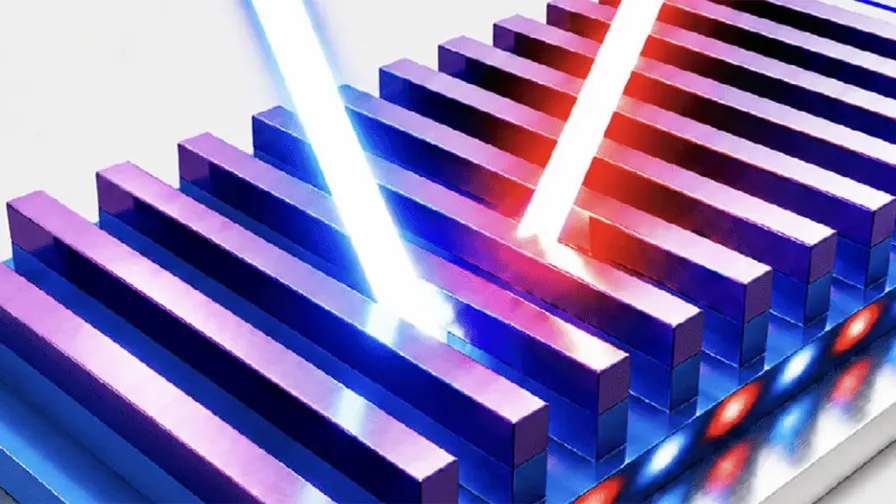
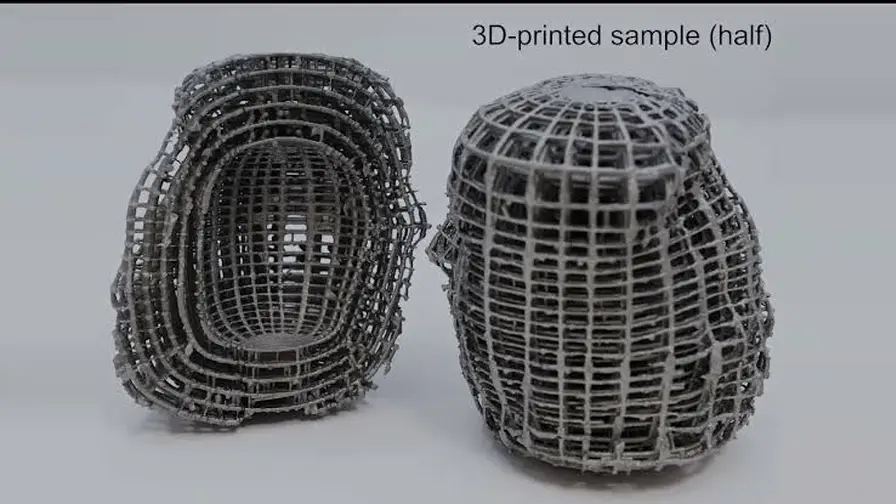
A diagram and photos of the experiment.
Two deliberate choices made the difference. First, the material: boron arsenide, a relatively new semiconductor noted for exceptional thermal conductivity. Its crystal lattice provides long, collision-free paths that let phonons travel farther than they would in most solids. Second, an ultra-small gold probe served double duty as both the source of heat and a nanoscale thermometer, enabling the team to create and map temperature patterns at a scale of hundreds of nanometers.
Material and measurement, simplified
- Boron arsenide gives phonons room to propagate without frequent collisions.
- The gold probe heats and senses with submicron precision.
- Measurements were taken at around 300 kelvin, roughly 27 °C or 80 °F.
These conditions produced focused phonon streams. Instead of diffusing evenly, heat concentrated along symmetry directions dictated by the crystal orientation, forming distinct rays. The researchers observed phonons traveling coherently for about 250 nanometers, a modest distance in absolute terms but a substantial span for demonstrating quantum-directed heat flow at room temperature.
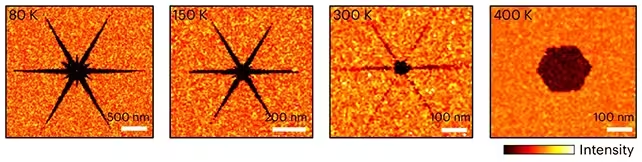
Phonon patterns at different temperatures, with ordinary diffusive heat flow winning out at the highest temperature (far right).
Why this matters
Quantum control of heat at ambient conditions opens practical doors. Electronics and quantum devices struggle with thermal bottlenecks: heat reduces performance, creates noise and limits scaling. If heat can be guided like electricity or light—focused, redirected, or channeled away from sensitive components—engineers gain a new design lever for devices ranging from conventional laptops to nascent quantum processors.
"This is a fundamental observation that enables us to think about thermal management in a new way," says Yongjie Hu, a mechanical and aerospace engineer involved in the work. "By enabling heat to be guided, focused and redistributed with nanoscale precision at room temperature, the discovery establishes a foundation for quantum thermal engineering."
Beyond immediate device design, the experiment challenges a prevailing assumption: that wave-governed, exotic transport phenomena belong only to low-temperature physics. The authors write that their results demonstrate wave-like, quantum transport can become experimentally accessible at technologically relevant temperatures in advanced materials. That shifts the research agenda from proof-of-principle demonstrations to applied engineering questions.
Potential paths forward
Some of the near-term questions are practical. Can these effects be reproduced across larger areas and in other high-thermal-conductivity crystals? Can device architectures incorporate crystalline funnels that steer heat away from hotspots? The UCLA team’s modelling indicates the pattern of rays depends on the 3D atomic arrangement, suggesting designers could tailor thermal pathways by controlling orientation or by engineering composite structures.
Longer-term prospects include hybrid strategies that couple phonon control with electronic and photonic management. Manipulating how phonons interact with electrons or photons could lead to more efficient thermoelectrics, quieter quantum bits and novel sensors that exploit directed heat flow as a signal rather than a nuisance. For now the results are a compelling proof of concept, showing that quantum thermal phenomena can cross the threshold from cryogenics into ambient reality.
Expert Insight
Dr. Maya Sanchez, a materials physicist who was not part of the study, offers a practical read: "Demonstrating directional phonon transport at room temperature is a milestone. The immediate challenge is engineering reproducibility in device-relevant formats. If that can be done, thermal design will become another controllable parameter, like electronic band engineering or photonic crystal design."
Conclusion
The observation of phonon focusing at room temperature reframes how we think about heat in solid-state systems. What began as a focused experiment using boron arsenide and a nanoscale gold probe hints at a broader toolkit for thermal control. The road from lab demonstration to integrated technology is still long, but the map now includes a new route: quantum-informed thermal engineering at ambient conditions. For device designers and physicists alike, that is an invitation to rethink heat as a resource to be guided rather than a problem to be tolerated.

“The cosmos has always fascinated me. I write about space missions, astronomy, and the technologies pushing humanity beyond Earth.”

Discussion
Leave a Comment
Comments (2)
Is this even true? 250 nm coherence at 300K sounds tiny and only in near-perfect crystals. How do defects, interfaces, real device layouts affect this? feels lab‑scale for now
wow, heat behaving like laser beams at room temp? this is wild. boron arsenide for the win? kinda makes me wanna build tiny heat optics, lol. amazing but kinda scary